Author: punegcchub

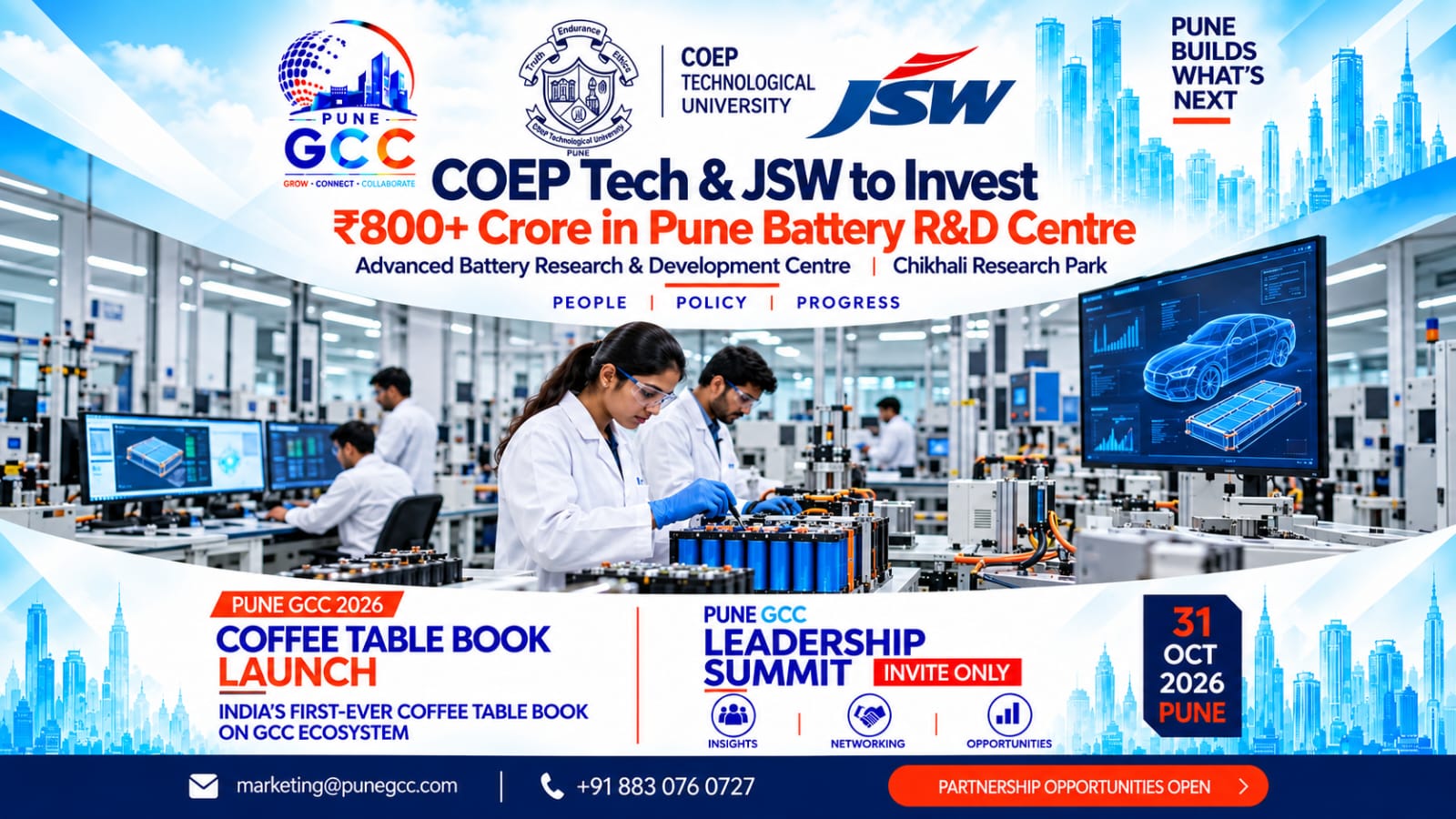
  • COEP Tech and JSW to Invest Over ₹800 Crore in Advanced Battery R&D Centre in Pune

    COEP Tech and JSW to Invest Over ₹800 Crore in Advanced Battery R&D Centre in Pune

    Pune: Pune is set to strengthen its position in advanced technology and deep-tech research with COEP Technological University and JSW Projects joining hands to establish an Advanced Battery Research & Development Centre at COEP Tech’s Chikhali Research Park.

    The two organisations have signed a Memorandum of Understanding for the project, which will involve a combined investment of more than ₹800 crore across two phases.

    The centre will focus on developing and validating indigenous battery technologies, including lithium-ion, sodium-ion and other advanced-chemistry battery cells. The first phase will establish a Cell Research and Development Centre focused on battery-cell design, simulation and prototyping. The second phase will expand the facility into a Cell Validation Centre with capabilities to produce cells ranging from 100 Ah to 600 Ah.

    The initiative will bring together COEP Tech faculty, researchers and students with JSW engineers, creating a platform for joint research, academic projects, publications, intellectual property development and the transition of battery technologies from laboratory research towards industrial applications.

    The centre is expected to support technology development for electric mobility, grid-scale battery energy storage and clean-energy applications. According to the organisations, the project could also catalyse more than 1,000 jobs across engineering, research, manufacturing and allied areas.

    The development adds another important dimension to Pune’s evolving technology ecosystem, where academic institutions, engineering talent and industry are increasingly collaborating on advanced technologies. The Chikhali Research Park initiative could further strengthen Pune’s role in battery research, energy storage and next-generation mobility technologies.

    With significant investment flowing into research infrastructure and industry-academia collaboration, Pune continues to expand beyond its established technology and automotive strengths into emerging areas of deep tech, clean energy and advanced engineering.

  • Pune Growth Hub: $220 Billion Economic Vision by 2036 with 20 Lakh New Jobs

    Pune Growth Hub: $220 Billion Economic Vision by 2036 with 20 Lakh New Jobs

    Pune: The Pune Economic Region is set for an ambitious decade of economic and infrastructure expansion under a comprehensive roadmap prepared through NITI Aayog’s Growth Hub initiative.

    The master plan, presented to Maharashtra Chief Minister Devendra Fadnavis at a high-level meeting at Sahyadri Guest House, proposes expanding the region’s economy from approximately $68 billion in FY 2025–26 to $200–220 billion by FY 2035–36.

    The roadmap identifies 58 priority projects, requiring an estimated ₹9–10 lakh crore in investment, with a target of creating 15–20 lakh additional jobs over the next decade.

    The plan covers the Pune Municipal Corporation (PMC), Pimpri-Chinchwad Municipal Corporation (PCMC) and Pune Metropolitan Region Development Authority (PMRDA) areas. The planning process began in August 2025 and involved NITI Aayog, the Government of Maharashtra and the Pune International Centre, with consultations involving citizens, industry and educational institutions.

    The Pune Economic Region currently contributes approximately 11–12% of Maharashtra’s overall income, while its real economic growth rate is estimated at around 6–6.5%.

    The Growth Hub roadmap proposes accelerating this rate to approximately 10% annually, supporting Maharashtra’s broader ambition of becoming a $5 trillion economy by 2047.

    With a population of around 15 million, the Pune Economic Region is being positioned for growth that combines industrial expansion, technology, infrastructure, housing, tourism and environmental sustainability.

    A major focus of the roadmap is the development of advanced manufacturing and technology-driven industries.

    The identified growth areas include:

    • Automotive and electric vehicles
    • Engineering goods and precision manufacturing
    • Defence technology
    • Robotics and drones
    • Electronics and semiconductors
    • Information technology, Global Capability Centres and artificial intelligence
    • Biotechnology and life sciences

    The roadmap proposes initiatives such as EV and future-mobility hubs, high-tech engineering parks, defence technology facilities, robotics centres, electronics and semiconductor manufacturing, IT facilities, GCCs and AI hubs.

    These high-technology sectors are expected to have the potential to generate 4–5 lakh additional jobs.

    For Pune’s growing GCC ecosystem, the emphasis on Global Capability Centres, AI, advanced engineering, electronics, semiconductors and high-tech manufacturing could create additional opportunities for global companies establishing or expanding operations in the region.

    Employment generation is one of the central objectives of the Growth Hub roadmap.

    Pune currently has approximately 56 lakh jobs, while the plan envisages total employment increasing to around 74–76 lakh over the next decade.

    The additional employment opportunities are expected to emerge across manufacturing, technology, services, healthcare, education, tourism, agriculture, food processing, logistics and related sectors.

    The roadmap also proposes expanding the startup ecosystem to more than 10,000 active ventures and reskilling 1.5–2 lakh technology professionals in areas including AI, cloud computing and cybersecurity.

    Mobility is another major pillar of the proposed transformation.

    The Growth Hub plan targets increasing the share of public transport in daily travel from approximately 13% to 50%.

    The proposed infrastructure expansion includes:

    250 km of Metro network

    12,000–14,000 city buses

    11 railway projects

    13 major road projects

    Six multimodal transport hubs

    The objective is to create a more integrated regional transport system while reducing dependence on private vehicles and improving connectivity between residential, industrial and employment centres.

    With employment and population expected to grow, housing has been identified as an important component of the roadmap.

    The plan proposes 4–5 lakh affordable homes for different income groups, workers, students and technology professionals.

    This includes approximately one lakh hostel units for industrial workers.

    The roadmap also proposes cluster-based redevelopment and aims to rehabilitate around 90% of eligible slum-dwelling families by 2036.

    Tourism is another major growth opportunity identified in the roadmap.

    The plan proposes developing multiple tourism segments, including heritage, adventure, wellness, events, wildlife and religious tourism.

    Among the proposals are a Chhatrapati Shivaji Maharaj Fort Circuit connecting Shivneri, Lohagad, Rajgad and Sinhagad; water tourism hubs around Pawna and Bhatghar; a 600-km Sahyadri trekking trail; a Junnar leopard safari; wellness and medical tourism initiatives; and event and entertainment infrastructure around the Pune International Exhibition and Convention Centre.

    The broader objective is to position the Pune Economic Region among India’s top 10 tourism destinations.

    The roadmap also looks beyond Pune’s urban economy, with agriculture and food processing identified as important drivers for the region’s rural belts.

    The plan targets increasing the combined Gross Value Added from agriculture and food processing from approximately $5 billion to $10–12 billion.

    Priority areas include horticulture, dairy, food processing, cold storage and cold-chain infrastructure, with products such as grapes, bananas, pomegranates, figs and strawberries identified as opportunities. Biofuel-related initiatives are also proposed.

    The roadmap estimates that the Pune Economic Region could require an additional 200 million litres of water per day as population and economic activity expand.

    Proposed measures include additional water allocation, supplies from the Bhama basin, wastewater reuse, improved distribution efficiency and desilting of water-storage infrastructure.

    The objective is to strengthen water security alongside long-term urban and industrial expansion.

    The proposed economic transformation is accompanied by a strong focus on skills.

    Training and reskilling initiatives are expected to focus on areas such as electric vehicles, electronics, robotics, biotechnology, artificial intelligence, cloud computing and cybersecurity.

    The roadmap also places emphasis on increasing workforce participation and creating opportunities for young people and women.

    To coordinate the implementation of the Growth Hub roadmap, a multi-level governance structure has been proposed.

    The framework includes a Governing Council chaired by the Chief Minister, a State Steering Committee headed by the Chief Secretary, a Pune Growth Hub Steering Committee, and a Project Management Unit associated with PMRDA.

    The proposed structure is intended to coordinate multiple government departments and agencies involved in infrastructure, industry, transport, housing and other development projects.

    The proposed Growth Hub strategy has particular relevance for Pune’s rapidly developing Global Capability Centre ecosystem.

    The roadmap explicitly identifies GCCs, information technology and artificial intelligence among the areas for future growth, alongside semiconductors, advanced engineering, electronics, defence technology, robotics and EVs.

    As these sectors expand, Pune’s role could increasingly connect global technology operations with advanced manufacturing, engineering, R&D and innovation capabilities.

    For the Pune GCC ecosystem, the next decade could therefore involve not only an increase in the number of centres, but also greater diversification into AI, engineering, product development, cybersecurity, semiconductor technology, advanced manufacturing and global R&D functions.

    The Pune Growth Hub roadmap presents a long-term development framework built around a combination of economic growth, technology, manufacturing, employment, mobility, housing, tourism and sustainability.

    Its headline targets — a $200–220 billion economy, ₹9–10 lakh crore of proposed investment, 15–20 lakh additional jobs and a 250-km Metro network by 2036 — underline the scale of the proposed transformation.

    The implementation of these ambitions will depend on project execution, financing, inter-agency coordination, policy decisions and timelines adopted by the government.

    For Pune, however, the roadmap provides a clear indication of the direction being proposed for the region’s next phase of growth: more technology, deeper industrial capabilities, stronger global connectivity and a larger role in Maharashtra’s economic future.

    Pune GCC will continue to track developments around the Pune Growth Hub, GCC expansion, technology investments and the evolving business ecosystem across the Pune Economic Region.

  • Baker Hughes Opens New Pune Technology Centre, Strengthening Its Technology and Innovation Presence

    Baker Hughes Opens New Pune Technology Centre, Strengthening Its Technology and Innovation Presence

    Baker Hughes has opened its new Pune Technology Centre (PTC), bringing nearly 350 colleagues together across engineering, technology, sourcing and business functions under one roof. The new centre marks another step in the company’s continued investment in its people, technology capabilities and innovation ecosystem in India.

    The Pune Technology Centre serves as an integrated engineering and digital innovation hub, bringing together multidisciplinary expertise across hardware engineering, mechanical design, embedded firmware, application software, data science, DevOps and emerging digital technologies. By bringing these capabilities together, the centre enables teams to collaborate more closely and develop end-to-end solutions to address complex challenges across the energy value chain.

    Designed to encourage connection, creativity and collaboration, the new workspace reflects Baker Hughes’ focus on creating an environment where talented professionals, innovative ideas and emerging technologies can come together. The centre is expected to support the company’s broader efforts to develop solutions that help make energy safer, cleaner and more efficient.

    The opening of the Pune Technology Centre also highlights Pune’s growing importance as a destination for global engineering, technology and digital capabilities. The expansion of such multidisciplinary technology centres further strengthens Pune’s position within India’s evolving Global Capability Centre ecosystem, bringing together specialised talent and globally relevant innovation from the city.

    As Baker Hughes begins this new chapter in Pune, the new technology centre represents more than a change of location. It reflects a continued commitment to collaboration, innovation and creating greater value for customers across the global energy industry.

    New address. Shared purpose. Endless possibilities.

  • RUCKUS Networks Deepens Commitment to India Through Local Manufacturing in Pune

    RUCKUS Networks Deepens Commitment to India Through Local Manufacturing in Pune

    Pune, Maharashtra | September 2026 — RUCKUS Networks, a Belden brand, is expanding its footprint in India into local manufacturing, leveraging Belden’s established manufacturing capabilities in Pune to produce ICX Ethernet switches for customers across the country.

    The development marks an important operational milestone following Belden’s acquisition of RUCKUS Networks and strengthens the company’s presence across innovation, engineering, customer success and manufacturing. The Pune manufacturing footprint is expected to bring RUCKUS Networks closer to customers and partners while expanding its ability to support India’s growing demand for digital infrastructure and networking solutions.

    RUCKUS Networks’ India presence extends beyond manufacturing. Bengaluru serves as the company’s largest global site for research and development and customer success, while its Research & Design centre in Chennai, established in collaboration with IIT Madras Research Park, supports software development, engineering talent and networking innovation. With the addition of Pune, the company is creating a broader end-to-end operational footprint spanning innovation, customer engagement and production.

    The initial manufacturing focus in Pune is on the company’s ICX Ethernet switching portfolio. The move also comes as India continues to strengthen its domestic electronics and networking equipment manufacturing ecosystem, with increasing emphasis on local production and domestic value addition.

    For Pune, the development further highlights the city’s growing role in advanced manufacturing and technology operations. The presence of global companies across engineering, research and development, digital infrastructure and manufacturing is contributing to Pune’s evolution as an important technology and industrial hub.

    RUCKUS Networks’ expansion adds another global technology player to Pune’s growing ecosystem and reflects the city’s ability to support increasingly integrated global operations — from engineering and innovation to manufacturing and customer delivery.

  • Beck & Pollitzer India Inaugurates New Office in Pune

    Beck & Pollitzer India Inaugurates New Office in Pune

    Pune, Maharashtra: Beck & Pollitzer India has inaugurated its new office in Pune, marking a new chapter for the company’s growing team and presence in the city.

    The inauguration was attended by Romain Prouvost, CEO of Beck & Pollitzer, who joined Suhas Kulkarni, Managing Director of Beck & Pollitzer India, and the India team to mark the occasion.

    A New Space for a Growing Team

    The new Pune office comes as Beck & Pollitzer India continues to expand its team. The company said the new space has been established to accommodate its growing workforce and support the team’s next phase of development.

    The inauguration also reflected the company’s connection with Pune’s local culture. As part of the welcome, members of the Beck & Pollitzer India team wore the Puneri Pagadi, the traditional turban associated with the city and its cultural heritage.

    The occasion brought together the company’s leadership and Pune team to celebrate the office opening and the progress of its India operations.

    Strengthening Presence in Pune

    The new office adds to Beck & Pollitzer’s presence in India and reflects the company’s continued development of its local team.

    With Pune emerging as an important destination for global companies establishing and expanding their operations, the opening of Beck & Pollitzer’s new office represents another addition to the city’s growing international business ecosystem.

    Beck & Pollitzer India’s new Pune office marks the beginning of its next chapter as the team continues to grow and build its presence in the city.

    Pune GCC Perspective

    The development is another example of a global company strengthening its footprint in Pune, contributing to the city’s expanding ecosystem of international businesses, leadership teams and global operations.

  • BAUER Maschinen GmbH Expands Production Network with New Facility in Pune

    BAUER Maschinen GmbH Expands Production Network with New Facility in Pune

    Pune, Maharashtra: German machinery manufacturer BAUER Maschinen GmbH has expanded its presence in India with the opening of a new production, sales and service facility in Pune.

    The new facility covers approximately 15,000 square metres and employs around 100 people. It will be integrated into BAUER Maschinen’s global production network while strengthening the company’s manufacturing, sales and service capabilities in the Indian market.

    Combining Global Expertise with Local Capabilities

    The Pune facility brings together BAUER Maschinen’s international manufacturing processes with its development and engineering expertise and local capabilities.

    The company aims to bring production, sales and service activities closer together while providing customers in India and the wider region with more direct and responsive support.

    The new location will particularly strengthen BAUER Maschinen’s local sales and service operations. Greater proximity to customers is expected to support faster coordination and improved assistance throughout the entire machine lifecycle.

    Pune Strengthens Its Role as an Industrial Hub

    The expansion adds to Pune’s growing industrial and engineering ecosystem, with the city continuing to attract global companies across manufacturing, technology and engineering.

    By integrating its Pune operations into its international production network, BAUER Maschinen is strengthening the city’s role within its global operations while expanding its long-term presence in India.

    “India is an important growth market for BAUER Maschinen. With our new facility in Pune, we are expanding our long-term presence in the country,” said Wulf Flos, Managing Director of BAUER Maschinen GmbH.

    “Pune will become an integral part of our international production network. At the same time, we are strengthening our local sales and service capabilities to be closer to our customers and provide them with even more direct support throughout the region.”

    With its new Pune facility, BAUER Maschinen is combining global manufacturing capabilities with local engineering, sales and service expertise, further expanding its footprint in one of India’s key industrial and business centres.

  • ESP Global Services Opens New 120-Seat Office in Pune, Strengthening Its Global IT Support Operations

    ESP Global Services Opens New 120-Seat Office in Pune, Strengthening Its Global IT Support Operations

    Pune | September 2026

    UK-based IT support and technology services company ESP Global Services has officially opened its new, larger office in Pune, marking an important milestone in the company’s continued growth in India.

    The new 120-seat office represents a significant expansion of ESP’s presence in Pune, five years after the company first established a small operation in the city.

    Since its initial setup, ESP’s Pune operation has grown into a multi-faceted and strategically important centre for the business, delivering a range of technology and support capabilities for both global customers and internal teams.

    The Pune team supports key functions including Service Desk, ServiceNow and IT support solutions, contributing to ESP Global Services’ broader global service delivery operations.

    From a Small Operation to a Growing Global Centre

    Over the past five years, ESP’s Pune presence has evolved considerably. The expansion into a larger 120-seat facility reflects the scale of this growth and the increasing importance of the Pune team within the organisation.

    The company has also highlighted the people behind this journey as a key part of its success. The Pune team brings together skilled technology professionals who have helped build a strong culture while supporting the company’s customers and operations across markets.

    The opening of the new office provides additional capacity for ESP’s Pune operations and creates a stronger platform for its next phase of growth.

    Strengthening Pune’s Global Technology Ecosystem

    ESP Global Services’ expansion adds to the growing presence of international technology and IT services companies in Pune.

    With its established technology talent pool, strong enterprise ecosystem and growing role in global business operations, Pune continues to attract companies looking to build and expand their global delivery capabilities.

    The opening of ESP Global Services’ new office further highlights the city’s position as an important hub for global technology, IT support and digital operations.

    As ESP enters its next phase in Pune, the new facility is set to support the company’s continued development while strengthening the role of its India team in delivering services to customers and teams globally.

  • Melexis Opens New Office in Pune, Strengthening Its Presence in India

    Melexis Opens New Office in Pune, Strengthening Its Presence in India

    Pune | September 23, 2026

    Global engineering and semiconductor technology company Melexis has strengthened its presence in India with the official opening of its new local office in Pune, Maharashtra.

    The new 340 sq. m. facility marks an important step in Melexis’ continued expansion in the Indian market. The company has been serving customers in India for more than 15 years, primarily through distribution partners. According to Melexis, sales in India have grown by more than 30% per year over the past decade, making the country an increasingly important market for its global operations.

    With the opening of its Pune office, Melexis is moving towards a more direct local operation, bringing its teams closer to customers and their specific application requirements. The facility will initially house a localized team focused on motor drivers and sensor support, strengthening Melexis’ technical and commercial capabilities in the country.

    Pune to Support Melexis’ Growth in Mobility and Energy

    Melexis’ expansion comes at a time when India’s mobility and energy sectors are undergoing significant technological transformation. The company is looking to support opportunities across two-wheeler mobility, vehicle electrification, solar applications and smart energy metering.

    The automotive segment remains an important part of the company’s India strategy. Melexis reported a 30% year-on-year increase in automotive sales in the first half of 2026, with the segment accounting for 46% of its local revenue. The company is also targeting opportunities created by the increasing electrification and electronic content of India’s high-volume two-wheeler market.

    Beyond mobility, Melexis is also looking to address India’s expanding solar and smart-energy ecosystem. The company is targeting applications in smart energy metering, including solutions designed to support anti-tampering requirements in smart meters.

    Focus on Local Engineering Talent

    Alongside its commercial expansion, Melexis plans to build its local engineering capabilities. The company said the new facility will support a growing team and that it plans to hire 15 professionals over the coming years.

    Melexis also plans to leverage India’s engineering talent ecosystem, including expertise in software, embedded systems and IC design, to strengthen its technical support and customer engagement capabilities.

    Pune’s Growing Role in Global Technology Operations

    The establishment of Melexis’ new Pune office adds another global technology company to the city’s expanding ecosystem of engineering, technology and innovation operations.

    Pune has increasingly emerged as a location for companies building specialized capabilities across automotive technology, semiconductors, engineering, electrification and digital innovation. Melexis’ decision to establish a dedicated local operation in the city further reflects the growing role of Pune in India’s global technology ecosystem.

    Melexis’ Pune presence will enable the company to work more closely with Indian customers while developing solutions aligned with the country’s evolving mobility and energy requirements.

    Melexis’ new Pune office represents the next phase of its India journey — bringing global semiconductor expertise closer to the customers, applications and technology opportunities shaping the country’s next stage of growth.

  • ‘Why Not Pune?’ Dialogue Brings Industry and Government Together to Accelerate Pune’s GCC Growth

    ‘Why Not Pune?’ Dialogue Brings Industry and Government Together to Accelerate Pune’s GCC Growth

    Pune | September 22, 2026

    Pune’s growing Global Capability Centre (GCC) ecosystem received a fresh boost with the high-level ‘Why Not Pune?’ dialogue organised by the Pune Municipal Corporation (PMC), bringing together more than 25 industry leaders and representatives from the IT, manufacturing, technology and emerging sectors.

    The dialogue focused on strengthening Pune’s position as a preferred destination for global companies, addressing industry requirements and identifying opportunities to accelerate investment and GCC expansion in the city.

    Maharashtra’s GCC Ambition

    Addressing the gathering virtually, Maharashtra Chief Minister Devendra Fadnavis highlighted the objectives of the Maharashtra GCC Policy 2025, which targets approximately 400 new GCCs and 400,000 high-skilled jobs across the state.

    The Chief Minister also highlighted Pune’s established ecosystem across technology, IT and manufacturing, as well as its skilled talent base. Ongoing infrastructure initiatives, including the Metro network, Ring Road and tunnel projects, were highlighted as part of the broader effort to improve connectivity and liveability in the city.

    Industry-Government Collaboration

    A key focus of the dialogue was understanding the challenges faced by companies operating in Pune and identifying practical interventions to support future growth.

    Discussions covered areas including:

    • Infrastructure development
    • Urban mobility and connectivity
    • Last-mile connectivity
    • Talent and skills
    • Ease of doing business
    • Requirements of existing and future GCCs

    The government also indicated its openness to considering industry suggestions and policy interventions to address emerging requirements of the GCC ecosystem.

    Building Pune’s Global GCC Position

    The recommendations emerging from the interaction are expected to contribute to an actionable roadmap for strengthening Pune’s business environment and supporting the next phase of GCC growth.

    The dialogue brought together representatives from the state government, Pune Municipal Corporation, district administration and industry, reinforcing the importance of sustained collaboration in shaping Pune’s future as a global business and technology destination.

    As Maharashtra moves forward with its GCC ambitions, initiatives such as ‘Why Not Pune?’ place Pune’s infrastructure, talent, innovation ecosystem and investment potential at the centre of the conversation.

    Pune’s GCC ecosystem is growing — and the next chapter will increasingly be shaped by collaboration between industry, government and the city.

  • Pendo Opens New Office in Pune, Expanding Its Global Technology Footprint

    Pendo Opens New Office in Pune, Expanding Its Global Technology Footprint

    Pendo, the Raleigh, North Carolina-based software company, has opened a new office in Pune, strengthening its presence in India and expanding its global technology footprint.

    Founded in 2013, Pendo provides a product experience platform that helps organisations understand user behaviour, improve software adoption, gather customer feedback and build better digital experiences. The company serves 14,000+ companies across 115 industries worldwide and has more than 850 employees across 10 global offices.

    Pendo’s Pune presence adds another global software technology company to the city’s rapidly expanding ecosystem. The new office is expected to contribute to Pune’s growing capabilities across software engineering, product development, artificial intelligence and digital innovation.

    The expansion further reflects Pune’s growing importance as a destination for global technology companies looking to build skilled teams and develop products and capabilities for international markets.

    With an increasing number of global companies establishing technology and innovation operations in the city, Pendo’s new Pune office adds to the momentum of Pune’s evolving Global Capability Centre ecosystem.

    Pune GCC welcomes Pendo to Pune and looks forward to its growth in the city.