
Author: punegcchub

  • Innovecture and Nexio Expand Strategic Technology Partnership with Global Engineering Center in Pune

    Innovecture and Nexio Expand Strategic Technology Partnership with Global Engineering Center in Pune

    Pune, October 2026: U.S.-based technology and engineering services firm Innovecture and U.S.-based payments technology company Nexio have expanded their strategic technology partnership through a Global Engineering Center (GEC) in Pune, further strengthening the city’s position as a global engineering and technology hub.

    The relationship between the two companies began in 2024 and has since evolved into a broader engineering partnership supporting Nexio’s global technology priorities. Through the Pune GEC, Nexio is expanding its technology presence in India to access specialised engineering talent, accelerate innovation and build greater flexibility into its global technology organisation.

    The Pune-based engineering team currently supports Nexio across several technology functions, including digital transformation, artificial intelligence and data, application modernisation, quality engineering, application support and IT operations.

    The expanded GEC will operate as an extension of Nexio’s global technology team, connecting engineering teams across India and the United States around common product objectives, technology priorities and innovation initiatives.

    The center will bring together capabilities spanning software engineering, data, AI, automation, quality engineering, application modernisation and IT operations. This integrated model is expected to provide Nexio with a scalable foundation to expand its technology and engineering capabilities while increasing the adoption of AI and automation.

    The Innovecture-Nexio partnership reflects the broader evolution of India’s role in global technology operations.

    Rather than functioning solely as a traditional offshore delivery centre, the Pune GEC is being positioned as an integrated part of Nexio’s global technology organisation. The model combines Nexio’s payments and product expertise with Innovecture’s engineering talent, technology capabilities and delivery ecosystem.

    The collaboration will support areas including payments technology, software engineering, AI, data, quality engineering and platform modernisation.

    The development also comes as global companies increasingly use Pune to build specialised engineering capabilities, access technology talent and support innovation across international operations.

    The expansion of the Innovecture-Nexio partnership adds to Pune’s growing profile as a strategic destination for Global Capability Centres, engineering organisations and technology innovation.

    The Pune GEC is expected to provide a platform for deeper collaboration between teams in India and the U.S., while supporting Nexio’s long-term technology roadmap.

    With increasing activity across AI, cloud, engineering, digital transformation and advanced technology functions, Pune continues to strengthen its role in the global technology ecosystem.


  • Colliers Facilitates ~170,000 Sq. Ft. Grade A Office Transaction for Leading IT Firm in Pune

    Colliers Facilitates ~170,000 Sq. Ft. Grade A Office Transaction for Leading IT Firm in Pune

    Pune, October 2026: Pune’s commercial real estate market continues to demonstrate strong demand for quality office infrastructure, with Colliers facilitating a significant Grade A office space transaction for a leading IT firm.

    The transaction involves approximately 170,000 sq. ft. of conventional office space at GBB, Kothrud, marking a significant office real estate deal in one of Pune’s supply-constrained micro-markets.

    The transaction was supported by Colliers’ Pune office services team, with Amruta Chandratre and Sakshi Talwad playing a key role in understanding the client’s requirements and identifying a suitable workplace solution.

    Navigating limited supply while balancing the priorities of multiple stakeholders, the team successfully facilitated the transaction through a collaborative and solution-oriented approach.

    The deal reflects the continued demand from technology and corporate occupiers for large-format, Grade A office spaces in Pune. As the city strengthens its position as a major technology, innovation and Global Capability Centre (GCC) destination, demand for strategically located and high-quality workplaces is expected to remain an important component of Pune’s commercial real estate growth.

    The Kothrud transaction further highlights the evolving nature of Pune’s office market, where occupiers are increasingly seeking spaces that align with their operational requirements, employee needs and long-term growth plans.

  • Santosh Gupta Joins Mizuho as Director of Data Engineering in Pune

    Santosh Gupta Joins Mizuho as Director of Data Engineering in Pune

    Pune, Maharashtra: Mizuho has strengthened its technology leadership presence in Pune with the appointment of Santosh Gupta as Director of Data Engineering.

    Gupta recently joined Mizuho and brings leadership experience in data engineering, technology and digital capabilities to his new role. His appointment comes as Mizuho continues to build and strengthen its technology ecosystem in Pune.

    In his initial weeks with the organisation, Gupta has highlighted Mizuho’s people-centric culture, collaborative working environment and emphasis on empathy and respect. He noted the organisation’s flat structure, where professionals across levels and functions are encouraged to exchange perspectives and contribute towards common goals.

    Gupta’s early experience also highlights the importance Mizuho places on creating an environment where ideas can flow freely, collaboration takes precedence over hierarchy, and leadership is demonstrated through listening and supporting others.

    His appointment adds further depth to Mizuho’s technology leadership in Pune and reflects the city’s growing role as a hub for global technology, data and financial services capabilities.

    As Pune continues to attract global financial institutions and expand its GCC ecosystem, leadership appointments such as Gupta’s underscore the city’s growing importance in driving technology and data-led transformation.

  • Autodesk Inaugurates New Pune Office, Marking a New Chapter in Its 19-Year Journey

    Autodesk Inaugurates New Pune Office, Marking a New Chapter in Its 19-Year Journey

    Pune, Maharashtra: Autodesk has officially inaugurated its new Pune office, marking a significant milestone in the company’s 19-year presence in the city and further strengthening its engineering and technology footprint in Pune.

    The new office was inaugurated by Raji Arasu, Chief Technology Officer at Autodesk, marking an important moment for Autodesk’s Pune technology community.

    Over the past 19 years, Autodesk’s Pune operations have evolved from a small office with a handful of employees into a significant engineering and technology community. The journey reflects the growing scale of Pune’s role in Autodesk’s global operations and its broader technology ecosystem.

    The new office is designed to support continued collaboration, innovation and engagement among Autodesk’s teams. Beyond the physical expansion, the new workplace represents the company’s continued investment in its people and its long-term presence in Pune.

    Autodesk’s expansion comes at a time when Pune continues to strengthen its position as a leading destination for Global Capability Centres (GCCs), engineering operations and technology innovation.

    The city has emerged as an important hub for global companies looking to build technology, product development, engineering and innovation capabilities. The expansion of established technology organisations such as Autodesk further contributes to this ecosystem.

    With its new office, Autodesk enters another chapter of its Pune journey, building on nearly two decades of engineering talent, collaboration and technological development in the city.

    Autodesk’s new Pune office is not just a new workplace—it marks the continuation of a 19-year journey and the company’s commitment to what lies ahead in Pune.

  • Pune’s GCC Ecosystem Gains Momentum as Office Leasing Reaches Decade High in H1 2026

    Pune’s GCC Ecosystem Gains Momentum as Office Leasing Reaches Decade High in H1 2026

    Pune, October 2026: Pune’s office market recorded a strong first half of 2026, with Grade-A gross office absorption reaching 6.4 million sq. ft., marking a 56% year-on-year increase and the highest half-yearly absorption recorded in the city in the last decade, according to the Savills India Office Market Watch – H1 2026.

    The performance also highlights the growing importance of Global Capability Centres (GCCs) in Pune’s commercial office ecosystem.

    GCCs Account for 42% of Pune’s Office Absorption

    GCCs leased approximately 2.7 million sq. ft. of office space in Pune during H1 2026, accounting for nearly 42% of the city’s total gross absorption.

    Among India’s top six office markets, Pune ranked as the third-largest GCC leasing market during H1 2026. The report notes transactions involving organisations such as BP Business Solutions, Accenture Solutions, Maersk Global Service Centres, Deutsche India, Optum Health & Technology and Boston Scientific, reinforcing the city’s position as an important destination for GCC operations.

    Technology Remains a Major Demand Driver

    Pune’s office demand remained diversified during the first half of 2026.

    The IT-BPM sector accounted for 40% of gross office absorption, followed by flexible workspaces at 16% and engineering & manufacturing at 15%. Healthcare & pharma accounted for 8%, while BFSI contributed 6%.

    This mix reflects Pune’s established strengths across technology, engineering, manufacturing and other knowledge-intensive industries.

    The report also notes that Pune’s GCC profile has strengthened over the past few years, with the GCC share of office absorption increasing from 39% to 45% between H1 2022 and H1 2026. The growth has been supported by demand from technology, engineering and manufacturing occupiers.

    Large-Scale Occupiers Continue to Shape the Market

    Large office transactions remained a defining feature of Pune’s H1 2026 market. Transactions of 100,000 sq. ft. and above accounted for 56% of total leasing activity, reflecting continued expansion by global occupiers and large enterprises.

    At the city level, the SBD East micromarket accounted for 44% of total absorption, followed by PBD West at 31%, SBD West at 14% and CBD at 10%.

    What the Numbers Mean for Pune’s GCC Ecosystem

    The H1 2026 data indicates that Pune’s GCC story is increasingly connected to the city’s broader office and business ecosystem.

    The combination of a strong technology base, engineering and manufacturing capabilities, skilled talent and an established commercial real estate market is supporting continued demand from global enterprises.

    With Pune’s office absorption reaching 6.4 million sq. ft. in H1 2026, and GCCs contributing approximately 2.7 million sq. ft., the city continues to strengthen its position within India’s evolving GCC landscape.

    Pune GCC Outlook

    Savills expects Pune’s office market to record approximately 9.0 million sq. ft. of gross absorption during 2026. Technology is expected to remain the primary driver of leasing demand in H2 2026, while flexible workspaces are expected to sustain their momentum. Healthcare & pharma, real estate, and research & consulting are also expected to contribute to leasing activity.

    For Pune’s GCC ecosystem, the trajectory highlights a broader shift: GCCs are increasingly becoming an anchor of office demand, while Pune’s technology, engineering and manufacturing strengths continue to support the city’s evolution as a global business destination.

  • Advanced Energy Opens New Global Capability Centre in Pune

    Advanced Energy Opens New Global Capability Centre in Pune

    Pune, Maharashtra: Advanced Energy has officially opened its new Global Capability Centre (GCC) in Pune, India, adding another global organisation to the city’s expanding GCC ecosystem.

    The new Pune centre will serve as a shared-services hub supporting global development roles for Advanced Energy. The centre is designed to strengthen collaboration between teams in India and colleagues across different regions and time zones, supporting the company’s global operations.

    The inauguration brought together Advanced Energy leaders and employees from across India. The event featured leadership remarks, a ribbon-cutting ceremony, traditional lamp lighting and a cake-cutting celebration, marking the beginning of the centre’s operations in Pune.

    Advanced Energy’s entry adds to the continued growth of Pune as a destination for global capability operations.

    The city has increasingly attracted multinational organisations establishing or expanding GCCs across technology, engineering, business services, research and development, finance and other specialised functions.

    For companies operating globally, Pune offers access to a strong talent base and an established technology and business ecosystem, while providing opportunities to build teams that work closely with international counterparts.

    Advanced Energy’s new centre reflects this broader evolution, with its Pune team expected to contribute to global development and shared-service functions while collaborating with colleagues across the company’s international operations.

    As more global organisations establish dedicated capabilities in the city, Pune’s role within India’s wider GCC landscape continues to expand.

    Pune GCC welcomes Advanced Energy to Pune and looks forward to following the growth and contribution of its new centre.

  • Hinjewadi–Shivajinagar Metro Nears Passenger Operations: A Major Connectivity Boost for Pune’s GCC Hub

    Hinjewadi–Shivajinagar Metro Nears Passenger Operations: A Major Connectivity Boost for Pune’s GCC Hub

    Pune’s Hinjewadi–Shivajinagar Metro Line 3 is moving closer to passenger operations, marking an important development for one of the city’s most significant technology and employment corridors.

    Five additional stations on the corridor have received safety clearance from the Commissioner of Metro Rail Safety (CMRS), taking the total number of stations cleared for passenger operations to 17 out of the planned 23. Officials have indicated that the remaining technical requirements are expected to be completed within the next 10–12 days.

    Why it matters for Hinjewadi

    Hinjewadi is one of Pune’s most important technology clusters and hosts a large concentration of IT companies, technology centres and Global Capability Centres (GCCs).

    The Metro Line 3 corridor has been planned specifically to improve connectivity between Hinjewadi and central Pune. According to PMRDA, the project is intended to address traffic challenges around Rajiv Gandhi IT Park, Hinjewadi and surrounding areas while supporting sustainable urban development.

    The elevated corridor stretches 23.203 km and comprises 23 stations, connecting key locations including Hinjewadi, Wakad, Balewadi, Baner and Shivajinagar.

    Connectivity and Pune’s GCC ecosystem

    For Pune’s growing GCC ecosystem, connectivity is an increasingly important part of the city’s business infrastructure.

    The Hinjewadi region serves as a major employment destination for technology and corporate professionals. Improved mass-transit connectivity can make commuting between the western technology corridor and central Pune more accessible, while strengthening connections between residential areas, commercial districts, educational institutions and employment hubs.

    The wider connectivity plan also includes a ₹426 crore last-mile connectivity project around Hinjewadi, aimed at improving access for metro passengers and nearby IT parks.

    As Pune continues to expand its presence as a GCC destination, infrastructure developments such as Metro Line 3 are becoming an important part of the city’s broader growth narrative.

    The Hinjewadi–Shivajinagar corridor is therefore not just a metro project—it is another piece of the infrastructure supporting Pune’s evolving technology and GCC ecosystem.

    Pune GCC will continue tracking the infrastructure, policy and business developments shaping Pune as a leading Global Capability Centre destination.

  • Citi Expands Pune Footprint with ~1 Million Sq. Ft. Office Space

    Citi Expands Pune Footprint with ~1 Million Sq. Ft. Office Space

    Pune’s GCC ecosystem gets another significant boost as Citi expands its presence in Kharadi.

    Pune continues to attract large-scale global operations, with Citi taking approximately 1 million sq. ft. of office space at Panchshil Business Hub in Kharadi.

    The expansion marks Citi India’s largest office space to date and is another important milestone in the company’s long-standing presence in Pune. Citi’s association with the city goes back to 2012, when it began its presence at EON Free Zone.

    A growing global operation

    Citi’s presence in India has grown considerably over the years. Its Citi Solutions Centers in India are now home to more than 35,000 colleagues, supporting businesses across more than 80 markets globally.

    Teams in India work across a wide range of functions, including technology, operations, analytics, risk, compliance and financial processes, as well as digital banking and emerging technologies.

    The latest expansion adds further scale to Citi’s operations in Pune.

    What it means for Pune

    For Pune’s GCC ecosystem, the development is another example of how global companies are continuing to expand their operations in the city.

    Kharadi has become an important location for BFSI and GCC operations, with companies increasingly using Pune to manage technology, analytics, operations and other global business functions.

    Citi’s expansion also reflects the changing scale of Pune’s GCC landscape. What was once largely associated with technology and IT services has developed into a much broader ecosystem spanning financial services, technology, analytics, risk management, operations and specialised global functions.

    As more global organizations deepen their presence in Pune, the city continues to strengthen its role as an important hub for global capability and business operations.

  • US-Based UKG Expands Pune Office, Building on Its Centre of Excellence

    US-Based UKG Expands Pune Office, Building on Its Centre of Excellence

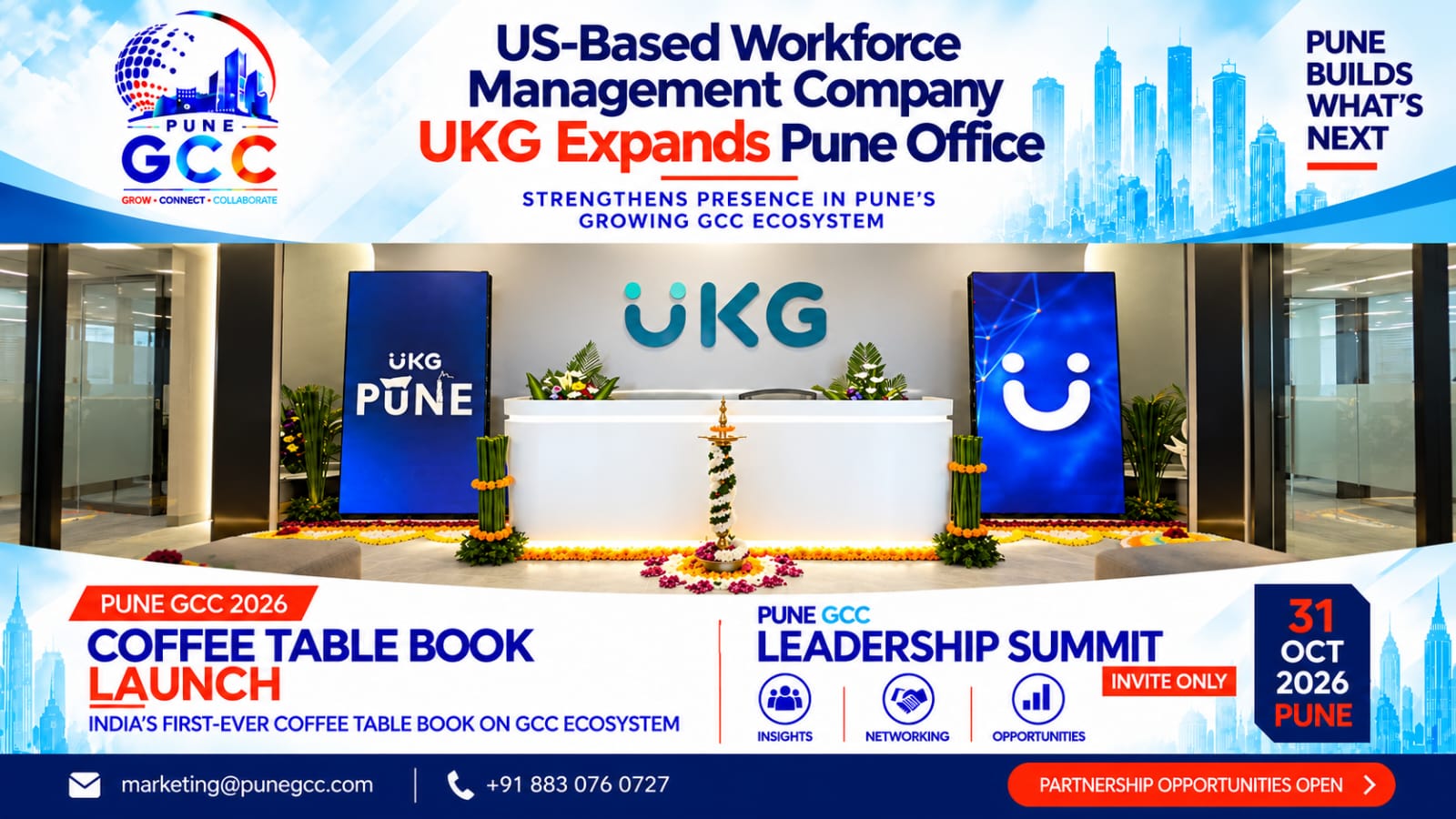
    Pune: US-based workforce management and HR technology company UKG (Ultimate Kronos Group) is expanding its office presence in Pune, adding further momentum to the city’s growing Global Capability Centre (GCC) ecosystem.

    The expansion comes after UKG opened its Pune Centre of Excellence in April 2025, marking a significant milestone in the company’s India growth journey. The new centre was established to support UKG’s product and technology ecosystem and serve customers across its global markets.

    At the time of the Pune launch, UKG announced that the new centre was expected to house up to 500 employees during 2025. The Pune team was planned to focus on product innovation, engineering and AI-powered workforce management platforms and solutions.

    UKG already had a significant India workforce when the Pune centre was launched, with more than 3,000 employees across the country. UKG has been present in India since 2007, making its Pune expansion part of a much longer India growth story.

    UKG’s Pune journey illustrates an increasingly important trend within the city’s GCC landscape.

    The company’s Pune Centre of Excellence was designed to leverage the city’s technology talent and engineering ecosystem while contributing to UKG’s global product and technology capabilities. UKG described Pune as a strategic location where engineering expertise and a culture of innovation could support the development of its global HCM and workforce management solutions.

    The initial plan to build a Pune team of up to 500 employees demonstrated the scale of UKG’s commitment to the city.

    The subsequent expansion of the Pune office further reflects how global companies are increasingly moving from establishing a presence to building deeper and larger capabilities in the city.

    UKG’s expansion comes at a time when Pune is strengthening its position as an important destination for Global Capability Centres.

    The city offers a combination of engineering and technology talent, a strong higher-education ecosystem and an established technology industry. These factors are enabling multinational companies to develop teams that contribute to global product development, engineering, customer experience and other critical functions.

    UKG’s current careers information identifies Noida and Pune as key UKG locations in India, with more than 3,000 employees across the two locations working across engineering, customer experience and finance.

    For Pune, the UKG story is therefore about more than an office expansion. It represents the evolution of a global company’s presence from a newly established Centre of Excellence toward a larger and deeper technology operation.

    As more multinational companies follow a similar path — enter, establish, scale and expand — Pune’s role within India’s GCC landscape continues to evolve.

    UKG’s growing footprint adds another chapter to that story.

    Pune GCC tracks the companies, investments, leadership developments and expansions shaping Pune’s Global Capability Centre ecosystem.

  • Pune Strengthens Japan Partnership, Invites Japanese Companies to Establish Global Service Centres

    Pune Strengthens Japan Partnership, Invites Japanese Companies to Establish Global Service Centres

    Pune, September 2026: Pune is looking to strengthen its economic and industrial relationship with Japan by inviting Japanese companies to invest in the city and establish regional offices and Global Service Centres.

    The development comes as Pune and Japan’s Okayama city prepare to mark 20 years of their sister-city relationship.

    During a recent courtesy visit to Japan, Pune Mayor Manjusha Deepak Nagpure met Ryuta Ibaragi, Governor of Okayama Prefecture. The discussions focused on strengthening economic, industrial, cultural and skill-development cooperation between Pune and Okayama.

    During the interaction, Pune highlighted its strengths across automotive, information technology, education, research and innovation and invited companies from Okayama to explore investment opportunities in the city.

    Japanese companies were also encouraged to consider Pune for regional offices and Global Service Centres, with the Pune Municipal Corporation indicating that it would support efforts to create a conducive environment for Japanese businesses.

    Potential areas of collaboration discussed include modern agricultural technology, healthcare, Ayurveda, yoga, research and other emerging sectors.

    A proposed joint skill-development and language centre in Pune is another key element of the discussions.

    The proposed centre could provide training in the Japanese language, Japanese work culture and technical skills, helping develop a talent pipeline for Japanese companies operating or planning to establish operations in Pune.

    Such an initiative could also strengthen employment opportunities for local professionals while helping Japanese businesses access talent familiar with their language and working environment.

    Pune and Okayama are preparing to commemorate two decades of their sister-city relationship.

    The Pune Mayor has proposed renewing the sister-city agreement to strengthen cooperation between the two cities in the coming years. An invitation has also been extended to the Governor of Okayama and a delegation of industrial and administrative representatives to visit Pune.

    The discussions are expected to provide further momentum to economic and cultural collaboration between the two cities.

    Greater engagement with Japanese businesses could open new opportunities for Pune’s growing Global Capability Centre (GCC) ecosystem.

    Japanese companies expanding their presence in Pune could potentially contribute to sectors such as:

    • Engineering and product development
    • Information technology and digital services
    • Research and development
    • Automotive and advanced manufacturing
    • Global business services
    • Technology and innovation

    Pune already has a strong combination of engineering talent, educational institutions, manufacturing capabilities and technology infrastructure, making the city relevant for global companies seeking specialised talent and international operations.

    The growing Japan–Pune relationship therefore represents another potential avenue for strengthening Pune’s position as a global hub for technology, engineering, innovation and business services.