Pune | September 4, 2026
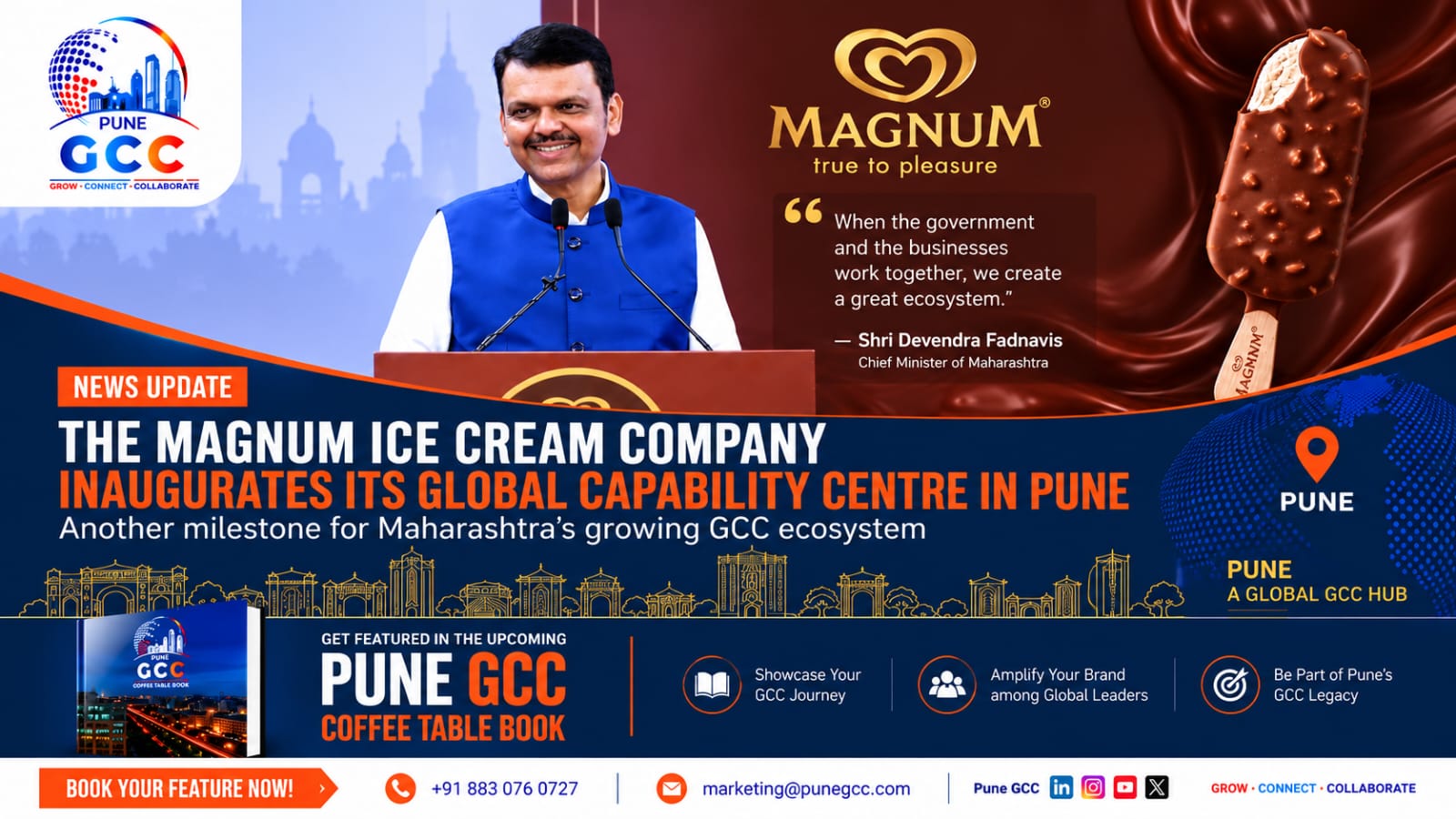
Maharashtra’s position as one of India’s leading destinations for Global Capability Centres (GCCs) received another significant boost with the inauguration of The Magnum Ice Cream Company’s Global Capability Centre (GCC) in Pune, marking a major milestone in the company’s India operations and in Pune’s evolution as a technology-led global business hub.
The GCC was inaugurated by Maharashtra Chief Minister Devendra Fadnavis in the presence of senior government officials, industry leaders and representatives of The Magnum Ice Cream Company.
Speaking at the inauguration, Chief Minister Fadnavis described the new centre as a testament to how effectively government-industry collaboration can translate investment commitments into tangible outcomes.
He congratulated CFO Abhijit Bhattacharya and the entire Magnum team for establishing the GCC in what he described as a “record time”, highlighting the speed with which the company’s investment commitment was converted into a fully operational facility.
From MOU to Action: Maharashtra’s Investment Story
Reflecting on the frequent perception that Memoranda of Understanding (MoUs) signed with governments can remain only on paper, the Chief Minister said the Magnum GCC demonstrates how quickly an investment commitment can become reality when government and business work together.
He emphasised that the inauguration was proof that Maharashtra’s investment facilitation ecosystem is focused on execution rather than merely announcements.
According to the Chief Minister, the experience of companies such as Magnum is particularly important because businesses that successfully establish and expand operations in the state become the strongest ambassadors for Maharashtra as an investment destination.
“Maharashtra is a place where business is taken seriously,” he said, stressing that the state views businesses as critical partners in generating employment and accelerating economic growth.
Magnum’s Growing Footprint Makes it a Maharashtra Global Company
The Chief Minister highlighted The Magnum Ice Cream Company’s expanding footprint across Maharashtra, pointing to its presence across Mumbai, Pune and Nashik.
The company has its regional headquarters in Mumbai, its newly inaugurated GCC in Pune, and its manufacturing presence in Nashik.
With the Pune GCC expected to employ more than 1,000 people, alongside the creation of indirect employment opportunities, the facility represents a significant addition to Maharashtra’s technology and business services ecosystem.
Fadnavis described Magnum as increasingly becoming a “Maharashtra global company”, while thanking the company’s leadership for choosing the state for its expansion.
He also welcomed the company’s indication that its future ventures would continue to have a presence in Maharashtra.
A Next-Generation GCC Built Around Technology
The Pune GCC is positioned as a next-generation capability centre that will leverage emerging technologies to support the company’s global operations.
The Chief Minister highlighted the role of automation, artificial intelligence, logistics and other advanced technologies in transforming Magnum’s production and distribution capabilities.
The GCC is expected to contribute beyond conventional support functions, becoming a technology and capability engine that can help drive efficiency, innovation and operational excellence across the company’s global ecosystem.
The development reinforces Pune’s growing role as a preferred location for multinational companies looking to establish technology, engineering, analytics, digital and global business capability operations.
Maharashtra Targets the Next Phase of the GCC Revolution
Fadnavis said Maharashtra has emerged as one of the most preferred destinations for GCCs and that the state intends to capture a significant share of the ongoing GCC expansion across India.
He pointed to Pune’s strong performance in GCC leasing and challenged the administration and local ecosystem to take the city to the number-one position.
The Chief Minister expressed confidence that Pune and Maharashtra could emerge as the leading GCC destinations by the end of 2026.
He also highlighted the scale of ambition behind Maharashtra’s GCC policy.
The state had set an initial target of attracting 400 GCCs in the first year of the policy. According to the Chief Minister, the number of GCCs attracted had already crossed 130, with Maharashtra aiming to exceed 800 and potentially reach 1,000 GCCs through stronger implementation and continued investment facilitation.
Policy That Focuses on Implementation
A key message from the Chief Minister was that Maharashtra’s competitive advantage does not rest solely on announcing an attractive policy framework.
He stressed that the state’s differentiation lies in implementation.
According to Fadnavis, Maharashtra’s approach is to promise what it can deliver and then implement those commitments “in letter and spirit”.
This execution-oriented approach, he said, is critical to building confidence among global companies considering India expansion and choosing between competing locations.
The Magnum GCC, established in record time, was presented as a practical example of this investment facilitation philosophy.
Pune’s Next Transformation: From IT Hub to Future-Ready Urban Economy
The inauguration also became a platform for outlining Maharashtra’s broader vision for Pune and the Pune Metropolitan Region.
The Chief Minister acknowledged that Pune and the wider Pune region have expanded rapidly over the past several years, while infrastructure development has not always kept pace with urbanisation.
He said the government is now working on a comprehensive transformation programme covering Pune, Pimpri-Chinchwad and the wider PMRDA region.
The objective is to create a more livable, connected and globally competitive urban environment for businesses, employees and residents.
Fadnavis said the administration has prepared a comprehensive plan involving municipal corporations, the district administration, PMRDA and MIDC, with implementation expected to begin shortly.
He expressed confidence that significant improvements would become visible over the next two years, with the ambition of making the region one of the most sought-after places to live and work.
Mobility at the Centre of Pune’s Next Growth Phase
For a city increasingly attracting global companies and high-value talent, mobility will be a critical component of Pune’s future competitiveness.
The Chief Minister outlined a major infrastructure agenda designed to improve connectivity and reduce commuting challenges across Pune, Pimpri-Chinchwad and the broader metropolitan region.
Key initiatives highlighted include:
- Shivajinagar–Hinjawadi Metro
- Outer Ring Road
- Inner Ring Road
- High Capacity Mass Transit Route (HCMTR)
- Plans for HCMTR connectivity in Pimpri-Chinchwad
- New tunnel infrastructure
- Wider investments aimed at improving urban mobility and connectivity
Fadnavis said the objective is not simply to expand infrastructure but to significantly increase the speed and efficiency of movement across the metropolitan region.
The government has set an ambition to complete major components of this transformation by 2029, positioning Pune, Pimpri-Chinchwad and the PMR region as one of India’s most advanced mobility-enabled urban areas.
Building the Next Generation of GCCs—and a Government Capable of Supporting Them
In a particularly forward-looking observation, Fadnavis said innovation cannot remain limited to businesses.
As companies establish sophisticated GCCs that use AI, automation, analytics and advanced technologies, government institutions must also modernise their capabilities.
He noted that Maharashtra should look at developing Global Capability Centres within government itself, reflecting a broader vision of technology-enabled governance.
This convergence of business innovation, public-sector transformation and infrastructure development could become an important differentiator for Maharashtra as it competes for the next wave of global investments.
Pune’s GCC Story Enters a New Phase
The inauguration of The Magnum Ice Cream Company’s GCC comes at a time when Pune’s GCC ecosystem is expanding beyond its traditional technology and engineering strengths.
The city is increasingly emerging as a destination for global organisations seeking access to skilled talent, technology capabilities, business services, engineering expertise and a strong industrial ecosystem.
The Magnum investment adds another global brand to this expanding landscape and reinforces the role of Pune as a strategic location for global capability operations.
For Maharashtra, the development represents more than the opening of another corporate facility.
It reflects the state’s broader ambition to position itself as a global GCC powerhouse, while simultaneously transforming Pune into a future-ready, highly connected and globally competitive business and mobility hub.
As the Chief Minister concluded, the success of this ecosystem will depend on continued collaboration between government, industry and the wider business community.
With companies investing, government accelerating infrastructure and Pune’s talent ecosystem continuing to evolve, the next chapter of Maharashtra’s GCC story is already taking shape.
Pune is not simply becoming a destination for GCCs—it is positioning itself to become one of India’s defining global capability and business hubs.