
Tag: Pune Manufacturing

  • Tyrolit Group Opens 3,600 m² Production Facility in Pune to Strengthen Superabrasives Supply Across Asia

    Tyrolit Group Opens 3,600 m² Production Facility in Pune to Strengthen Superabrasives Supply Across Asia

    The new facility will manufacture specialised tooling solutions and provide CBN re-tipping services, reinforcing Pune’s position as a precision engineering and advanced manufacturing hub.

    PUNE, India: Austrian abrasives specialist Tyrolit Group has opened a new 3,600 m² production facility in Pune, expanding its manufacturing capabilities in India and strengthening its ability to supply specialised superabrasives to customers across the Asian market.

    The investment marks another step in the company’s efforts to strengthen its global production network and support customers with locally produced, high-quality solutions.

    The Pune facility will manufacture selected metal- and resin-bonded tooling solutions, including products from Tyrolit’s MidTec, Startec RC and Startec XP families. It will also offer vitrified cubic boron nitride (CBN) re-tipping services.

    Superabrasives, including diamond and CBN tools, are used in high-precision grinding and finishing applications. These processes are essential to manufacturing components that require exceptional accuracy and surface quality, including automotive parts, gears and aerospace components.

    By expanding its production presence in Pune, Tyrolit aims to strengthen regional supply capabilities and support the specialised tooling requirements of manufacturers across Asia.

    The facility’s re-tipping and finishing capabilities will provide Indian manufacturers with more local access to specialised services. Such services can help manufacturers maintain and restore grinding tools while reducing the need to send them overseas for this work.

    The combination of local production and specialised services strengthens the availability of advanced tooling solutions for precision-driven industrial applications.

    Tyrolit’s investment reflects Pune’s established role in India’s industrial landscape, supported by its manufacturing base and engineering capabilities. The city’s ecosystem serves a range of industries, including automotive, industrial engineering and advanced manufacturing.

    As global companies expand their production networks and regional supply capabilities, investments of this nature further highlight Pune’s importance as a destination for specialised manufacturing and industrial growth.

    Tyrolit’s new facility represents another development in Pune’s evolving industrial ecosystem, strengthening the city’s connections with global manufacturing networks.
  • Piyush Goyal Flags Off First-Ever JCB Export to New Zealand; Ashish Shelar Also Acknowledged

    Piyush Goyal Flags Off First-Ever JCB Export to New Zealand; Ashish Shelar Also Acknowledged

    Pune-made JCB machinery enters the New Zealand market as the India–New Zealand Free Trade Agreement opens new opportunities for Indian exporters.

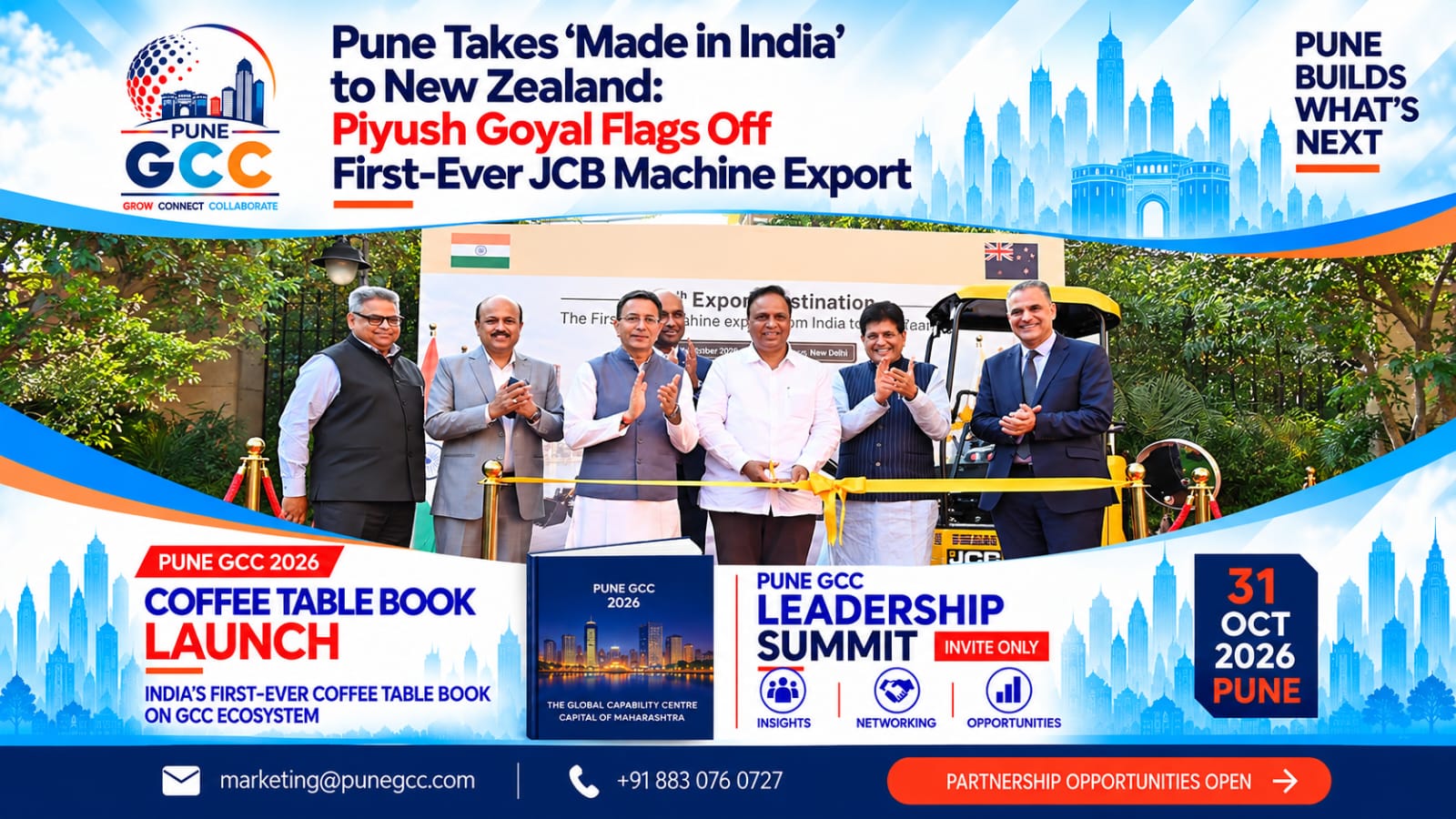
    PUNE, October 20, 2026: Pune has marked another milestone in global manufacturing with the first-ever export of a JCB machine to New Zealand. Union Commerce and Industry Minister Shri Piyush Goyal flagged off the machine, manufactured in Pune, Maharashtra. Maharashtra Minister Adv. Ashish Shelar was also acknowledged in connection with the announcement.

    The development comes as the India–New Zealand Free Trade Agreement (FTA) comes into effect on October 20, 2026. The agreement provides duty-free access for Indian exports to New Zealand, creating opportunities for manufacturers and exporters across multiple sectors.

    The export highlights Pune’s role as an important manufacturing centre, with established capabilities in engineering, automotive and industrial equipment. The city’s industrial ecosystem contributes to India’s growing presence in international markets.

    JCB India exports machinery to approximately 140 countries, demonstrating the global reach of its India-based manufacturing operations. The first shipment to New Zealand adds another destination to this international network.

    The India–New Zealand FTA is expected to strengthen bilateral trade by removing customs duties on Indian exports entering New Zealand. Engineering goods, textiles, apparel, footwear, pharmaceuticals and other sectors are among those positioned to benefit from improved market access.

    The agreement also includes New Zealand’s commitment to facilitate USD 20 billion in investment into India, with potential implications for manufacturing, infrastructure, services and innovation.

    For Pune, the milestone reinforces the city’s importance in India’s manufacturing and export landscape. Its combination of industrial capabilities, engineering expertise and global business connections positions it to contribute to the country’s expanding international trade relationships.

    As global companies continue to connect manufacturing, technology and business operations across markets, Pune remains an important part of India’s broader global growth story.

    Pune GCC Perspective

    Pune’s business ecosystem extends across global capability centres, engineering, manufacturing and technology. Milestones such as this reflect the city’s wider role in connecting India’s industrial strengths with international opportunities.

  • Hyundai Motor India Inaugurates Pune Plant, Announces ₹11,000 Crore Investment

    Hyundai Motor India Inaugurates Pune Plant, Announces ₹11,000 Crore Investment

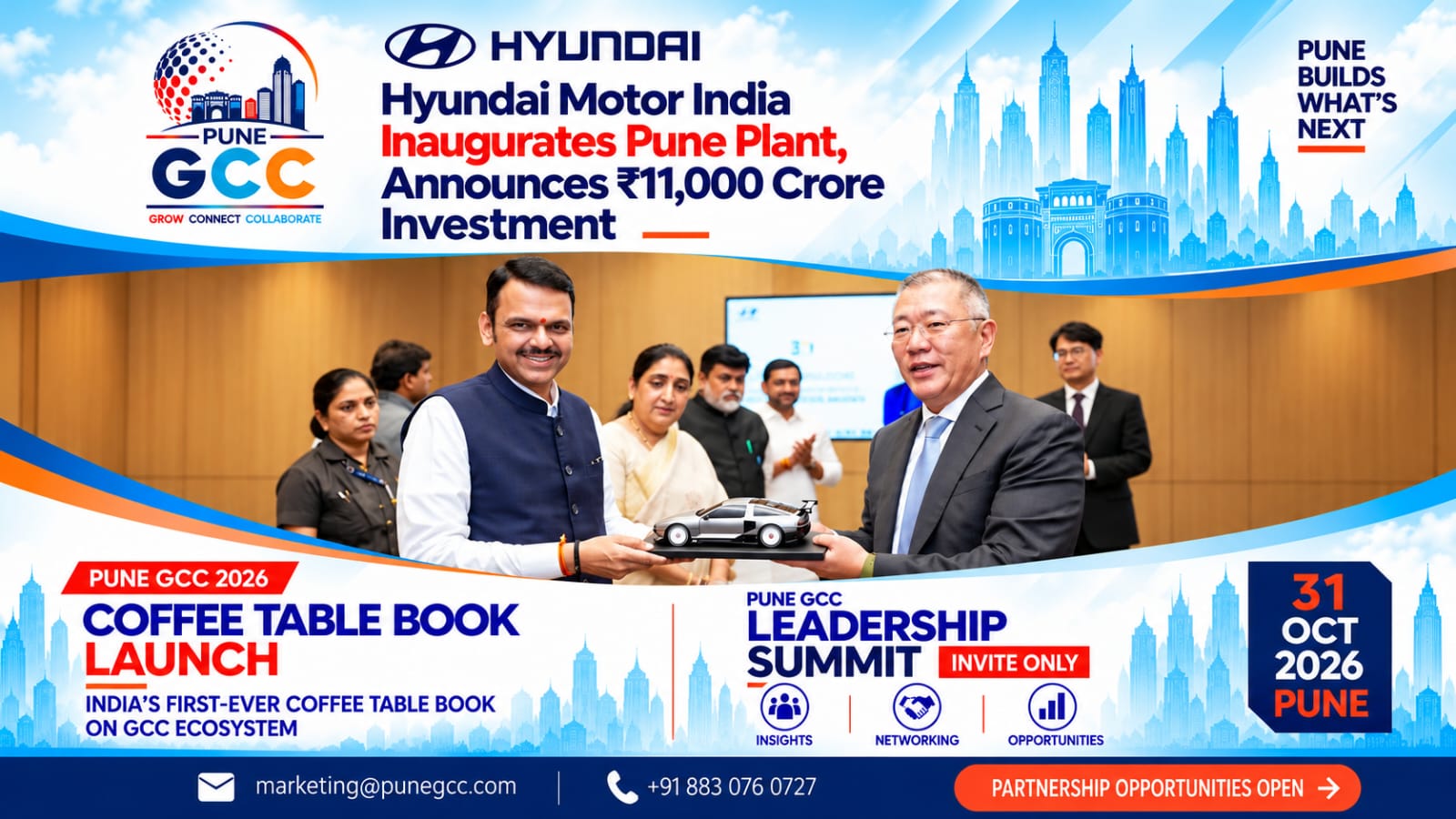
    Hyundai Motor India Limited (HMIL) inaugurated its Talegaon manufacturing plant in Pune, Maharashtra, on 14 October 2026, in the presence of Maharashtra Chief Minister Devendra Fadnavis. The inauguration marks a significant milestone in the company’s manufacturing expansion and reinforces Pune’s position as a key automotive production hub.

    Alongside the inauguration, Hyundai announced an investment of ₹11,000 crore in the Pune facility, underlining its long-term commitment to strengthening manufacturing operations in India.

    Production Capacity to Reach 3.2 Lakh Vehicles by 2030

    The Talegaon facility currently has an installed annual production capacity of 1.7 lakh vehicles. Hyundai plans to increase this capacity to 3.2 lakh vehicles annually by 2030, supporting its production expansion strategy and future market requirements.

    The plant adds to Hyundai’s manufacturing capabilities in India and is expected to play an important role in meeting domestic demand and supporting exports. The facility also incorporates advanced manufacturing technologies designed to improve production efficiency and quality.

    Strengthening Pune’s Automotive Ecosystem

    The inauguration represents a significant development for Pune’s established automotive and industrial ecosystem. The region is home to a strong network of automotive component manufacturers, engineering companies, suppliers and ancillary industries that support vehicle production.

    Hyundai’s investment is expected to create further opportunities across this ecosystem, strengthening supplier relationships and supporting the development of manufacturing capabilities in Maharashtra.

    Maharashtra’s Growing Manufacturing Significance

    The presence of Chief Minister Devendra Fadnavis at the inauguration underscores the importance of the facility to Maharashtra’s industrial development. Pune’s established manufacturing infrastructure, engineering talent and automotive supply chain continue to make the region an attractive destination for large-scale industrial investments.

    Hyundai Motor India’s plant inauguration and ₹11,000 crore investment announcement further strengthen Pune’s position in India’s automotive manufacturing landscape, highlighting the region’s continued role in industrial expansion and economic growth.

  • ₹2,320 Crore MSME Investment Set to Strengthen Pune’s Manufacturing Ecosystem

    ₹2,320 Crore MSME Investment Set to Strengthen Pune’s Manufacturing Ecosystem

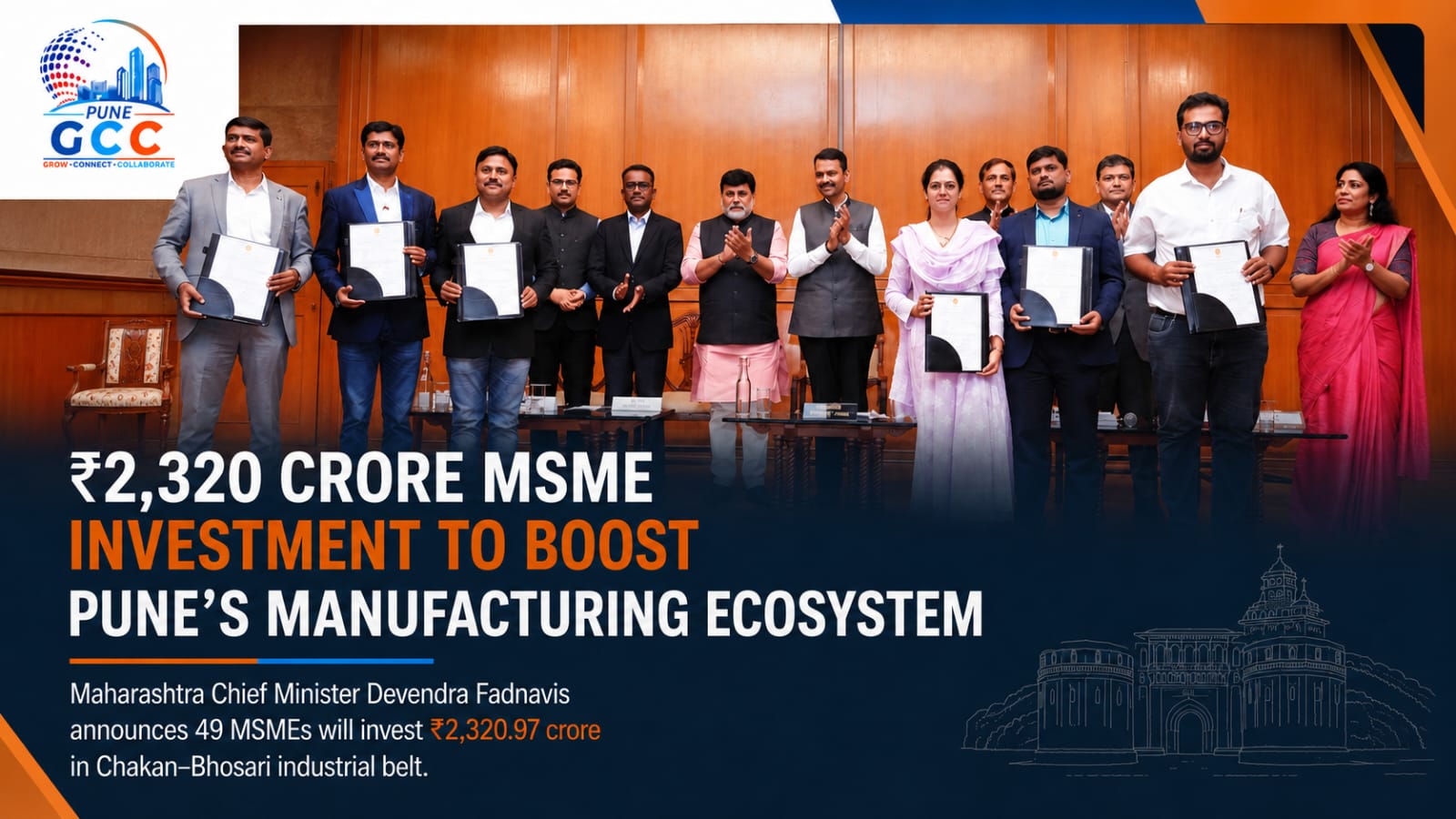
    Pune, Maharashtra: Pune’s Chakan–Bhosari industrial belt is poised for a fresh wave of manufacturing investment, with 49 MSMEs proposing investments worth ₹2,320.97 crore through Memorandums of Understanding (MoUs), according to Maharashtra Chief Minister Devendra Fadnavis.

    The proposed investments are expected to significantly expand manufacturing capacity across the region, generate thousands of employment opportunities and strengthen Pune’s already-established industrial ecosystem. The projects are expected to become operational within the next one to two years.

    Chakan, widely recognised as Pune’s “Motor City,” along with the Pimpri-Chinchwad industrial belt, has emerged as one of the region’s most important manufacturing clusters. The area is home to around 4,000 production units and supports a diverse range of industries, including automotive, engineering, electrical, electronics and logistics.

    The manufacturing ecosystem is further strengthened by the presence of major global and Indian companies such as Tata Motors, Mercedes-Benz, Mahindra and Volkswagen, alongside a large network of MSMEs and ancillary businesses.

    In another significant development, the Maharashtra government is planning to conduct its first MSME Census. The exercise will seek to map key parameters including employment, production, land requirements, labour needs and power requirements. The data is expected to help policymakers better understand the MSME landscape and plan future industrial infrastructure and support initiatives.

    The latest investment proposals highlight the continued expansion of Pune’s manufacturing base beyond its traditional automotive hubs. As new MSMEs add capacity and diversify industrial activity across Chakan, Bhosari and the wider Pune region, the city is strengthening its position as a major manufacturing and industrial destination in India.

    The fresh investment momentum also underlines the growing importance of Pune’s industrial ecosystem in driving manufacturing growth, employment generation and economic development in Maharashtra.