Tag: Pune GCC

  • DataPhi-AI Expands Its Pune Footprint with a New 100-Seater Office

    DataPhi-AI Expands Its Pune Footprint with a New 100-Seater Office

    Dubai-based DataPhi-AI strengthens its presence in Pune with a larger workspace designed to support continued growth, collaboration and innovation.

    PUNE: Dubai-based DataPhi-AI has expanded its presence in Pune by moving into a new 100-seater office, marking another significant milestone in the company’s growth journey.

    The larger workspace provides DataPhi-AI’s growing team with additional capacity to collaborate, exchange ideas and develop technology solutions across artificial intelligence, data analytics and data engineering. The expansion reflects the company’s continued commitment to building its operations and strengthening its talent base in Pune.

    The move comes as Pune continues to attract global technology companies and organisations looking to establish or expand their presence in India. With its strong talent pool, technology ecosystem and growing GCC landscape, the city has emerged as an important destination for businesses building global capabilities.

    For DataPhi-AI, the new office represents more than an increase in physical capacity. It creates an environment where teams can work more closely, innovate faster and contribute to the company’s broader technology and business objectives.

    The company’s expansion also adds to Pune’s growing story as a Global Capability Centre and technology hub, with international and technology-led organisations increasingly choosing the city for their operations, engineering capabilities and innovation functions.

    The new 100-seater facility is expected to support DataPhi-AI’s continued growth in Pune while providing its employees with a larger and more collaborative workplace.

    DataPhi-AI and Pune’s Growing GCC Ecosystem

    Pune has witnessed growing momentum in the Global Capability Centre ecosystem, with companies increasingly using the city not only for traditional support functions but also for technology, engineering, analytics, artificial intelligence and innovation.

    DataPhi-AI’s expanded Pune footprint is another example of this evolving ecosystem. The company’s focus on data and AI aligns closely with the technology capabilities that are increasingly becoming central to the next generation of GCCs.

    As Pune continues to strengthen its position on the global technology map, expansions such as this underline the city’s ability to support companies at different stages of their growth journey.

    Pune GCC congratulates DataPhi-AI on its new 100-seater office and wishes the entire team continued success as it expands its footprint and capabilities in Pune.

    Tags: DataPhi-AI, Pune GCC, Pune, GCC, Global Capability Centres, Artificial Intelligence, Data Analytics, Data Engineering, Technology, Office Expansion, Pune Technology, Business Growth, Innovation

  • Maharashtra’s GCC Policy 2025 vs IT & ITeS Policy 2023: What More Do GCCs Get?

    Maharashtra’s GCC Policy 2025 vs IT & ITeS Policy 2023: What More Do GCCs Get?

    Pune, September 2026: Maharashtra’s technology landscape is entering a new phase with the state’s Global Capability Centre (GCC) Policy 2025, which introduces a targeted incentive framework for global enterprises establishing or expanding captive operations. While Maharashtra’s IT & ITeS Policy 2023 created a broad baseline for technology enterprises, the GCC policy addresses the distinct capital expenditure, high-tier talent, R&D, and commercial leasing dynamics of Global Capability Centres.

    The critical distinction for corporate leaders is that the GCC Policy 2025 does not replace the 2023 IT & ITeS Policy. Instead, it builds upon that foundational architecture. Eligible GCCs can continue to access established institutional benefits under the 2023 framework while unlocking a specialized suite of incentives scaled specifically to GCC operations. For multinational corporations evaluating Maharashtra—and particularly Pune’s technology corridors—this creates a comprehensive two-tier incentive ecosystem.

    Under the 2023 IT & ITeS Policy, Maharashtra focused on the broader technology sector, covering IT-enabled services, emerging technologies, data centres, and AVGC (Animation, Visual Effects, Gaming, and Comics). Its primary objective was wide-scale employment generation and digital infrastructure development.

    The 2025 GCC Policy narrows its focus strictly to high-value, captive global operations. Underscoring this shift in value, the operational guidelines explicitly exclude third-party Business Process Outsourcing (BPO) units, customer support call centres catering to external clients, and pure-play sales or trading entities. To qualify, operations must be dedicated captive setups driving core capabilities such as artificial intelligence, product engineering, cybersecurity, data analytics, treasury management, and engineering research and development (ER&D).

    Categorisation is determined by Fixed Capital Investment (FCI in plant and machinery) or direct employment, spanning Small, Medium, Large, Mega, and Ultra Mega tiers. Furthermore, setting up a new GCC requires dedicated, separate premises; simple internal seat additions within an existing facility do not qualify as a new establishment.

    A core fiscal enhancement in the 2025 policy is the GCC-specific capital subsidy, offering up to 20% of eligible investment in plant and machinery, disbursed across five equal annual instalments:

    • Small GCC: Capped at ₹10 crore
    • Medium GCC: Capped at ₹20 crore
    • Large GCC: Capped at ₹50 crore
    • Mega GCC: Capped at ₹100 crore (with customised packages evaluated for Ultra Mega projects)

    Recognising that most GCCs establish operations in leased Grade-A commercial office space rather than building owned campuses, the policy introduces an alternative: eligible GCCs must choose between the capital subsidy or rental assistance—the two benefits are mutually exclusive.

    For Pune (classified alongside Mumbai under Zone I), eligible new GCCs can claim rental assistance of 10% of eligible actual rent (or Ready Reckoner rates, whichever is lower) for up to five years. Annual caps scale from ₹1 crore for Small GCCs up to ₹4 crore for Mega GCCs. This gives companies moving into Pune’s key enterprise micro-markets substantial operational expenditure relief without requiring heavy real estate capital commitments.

    Unlike earlier frameworks that focused on basic technical training reimbursements, the 2025 policy directly incentivises advanced talent acquisition.

    In Zone I, eligible GCCs can receive a salary subsidy equivalent to 40% of the salary component exceeding ₹1 lakh per month, capped at ₹50,000 per month per employee for up to three years. To maintain targeted fiscal deployment, this subsidy is subject to an annual cap of up to 100 employees per GCC unit. For centres hiring specialized data scientists, machine learning engineers, and system architects, this provides meaningful payroll offsets.

    Where a GCC meets prescribed diversity thresholds (such as maintaining a 50% workforce composition of women and persons with disabilities), the subsidy rate increases by an additional 10%, scaling to 50% in Zone I with an elevated cap of ₹60,000 per employee per month. GCCs can also access stipend support of up to ₹10,000 per month per intern under applicable state skill-development schemes, accelerating early-career talent pipelines.

    Research and development incentives are also significantly more concrete under the 2025 framework. Eligible GCCs allocating at least 2% of their FCI toward R&D can claim a 25% reimbursement on eligible operational R&D expenditure—up to ₹50 lakh annually, capped at ₹2 crore over four years. Importantly, GCCs undertaking joint research initiatives with recognized universities or higher education institutions within Maharashtra receive an additional 10% subsidy bonus. For Pune, home to a dense network of premier engineering, computational, and research institutes, this creates a direct incentive to build institutional industry-academia research hubs.

    Operating cost measures also include:

    • Power tariff subsidies of ₹1 per unit in Zone I for five years (subject to an annual ceiling of ₹20 lakh).
    • Electricity-duty exemption for 10 years.
    • 50% statutory fee reimbursement for domestic and international patent filings (capped at ₹50 lakh per unit).

    To ensure long-term value creation, the operational guidelines require beneficiary GCCs to maintain a mandatory operative period of at least 10 years from the issuance of their first Registration Certificate, backed by annual operational and statutory compliance filings. Existing centres expanding in Pune can also qualify by demonstrating a minimum 25% net increase in Gross Fixed Capital Investment alongside a 25% net addition in permanent non-supervisory headcount.

    The specialized GCC incentives operate alongside the overarching structural protections of the IT & ITeS Policy 2023. Eligible GCCs retain access to:

    • Stamp duty concessions and exemptions based on zone and IT park categorization.
    • Additional Floor Space Index (FSI) for designated parks.
    • Open access power procurement and industrial property tax parity.
    • Permissibility for 24×7×365 continuous operations under formal industry status.
    • Dedicated statutory facilitation via MAITRI’s single-window clearance cell.

    Maharashtra’s target is to attract 400 new GCCs and create four lakh high-skilled jobs through 2030. The structural divergence between the two policies is distinct: the IT & ITeS Policy 2023 built the foundational infrastructure for technology services, while the GCC Policy 2025 creates targeted financial mechanisms to attract global corporate headquarters, deep-tech engineering, and strategic decision-making centers. For Pune, this two-tier model positions the city not merely as a delivery outpost, but as India’s primary locus for high-value captive innovation.


  • Michigan-Based AI Engineering Company Altimetrik Opens Its Second Centre in Pune

    Michigan-Based AI Engineering Company Altimetrik Opens Its Second Centre in Pune

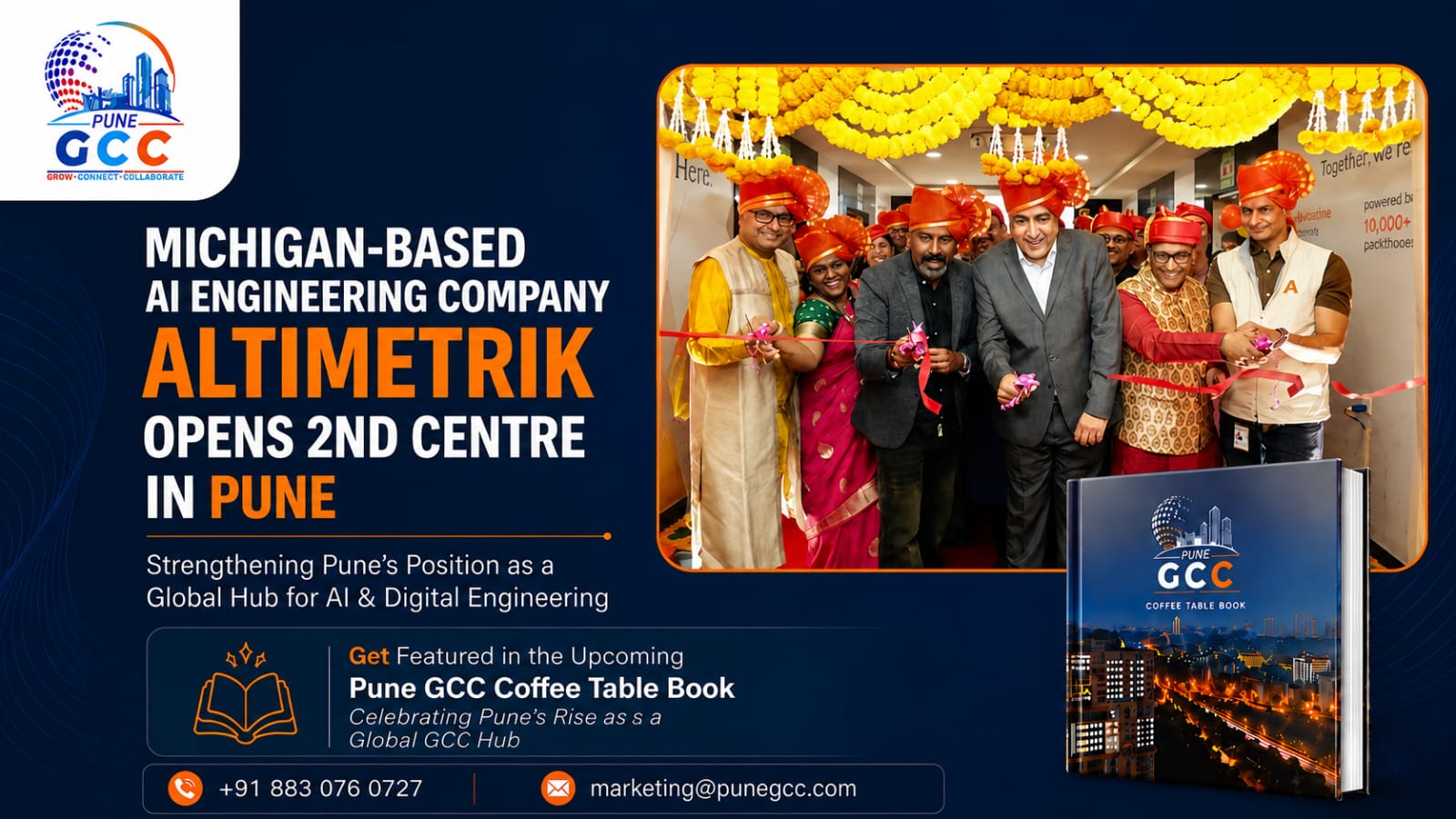
    Pune: Pune’s position as a leading destination for artificial intelligence, digital engineering and Global Capability Centre (GCC) operations continues to strengthen as Altimetrik, a Michigan-based AI engineering company, expands its footprint in the city with the opening of its second centre in Pune.

    Headquartered in Southfield, Michigan, Altimetrik is an AI-native digital engineering company that works with global enterprises to accelerate digital transformation, modernise technology platforms and develop AI-powered solutions.

    The company’s expansion in Pune highlights the growing importance of the city within its global engineering and technology operations. With enterprises increasingly investing in Artificial Intelligence, Generative AI, data engineering, cloud technologies, digital platforms and automation, Pune has emerged as a strategic location for companies building advanced technology and engineering capabilities.

    Altimetrik has been expanding its focus on enterprise AI as organisations move beyond experimentation towards deploying AI solutions at scale. The company has developed capabilities across AI engineering, data and analytics, cloud, product engineering and digital transformation, supporting enterprises across multiple industries.

    The company has also been strengthening its AI ecosystem through partnerships with leading technology companies, including OpenAI, Google Cloud, Anthropic, Snowflake and Databricks. Its AI-focused initiatives are aimed at helping organisations accelerate the adoption of AI and integrate intelligent technologies into their core business operations.

    Altimetrik was recently named an OpenAI Advanced Partner, reflecting its growing focus on enterprise AI engineering and the deployment of AI solutions in production environments.

    Pune Strengthens Its Position as an AI and Engineering Hub

    The opening of Altimetrik’s second centre adds to the growing list of global technology companies expanding their engineering, technology and innovation operations in Pune.

    The city has established itself as one of India’s leading technology ecosystems, supported by a strong talent pool, established IT infrastructure, a large presence of multinational corporations and a rapidly expanding GCC ecosystem.

    Pune is increasingly attracting organisations looking to establish or expand centres focused not only on traditional IT services but also on AI engineering, software product development, cybersecurity, data science, cloud computing, digital transformation and global R&D.

    Altimetrik’s latest expansion is therefore significant in the broader context of Pune’s GCC growth. The company’s focus on AI and digital engineering aligns closely with the changing nature of GCCs in the city, where global organisations are increasingly moving towards higher-value technology, innovation and product-led functions.

    Growing Global Technology Footprint

    Altimetrik’s second Pune centre is expected to further support its engineering and technology capabilities while strengthening its ability to serve global customers from India.

    The expansion also reflects the continued confidence of international technology companies in Pune as a location for building specialised technology teams and accessing skilled engineering talent.

    As global enterprises accelerate their investments in AI and digital transformation, Pune is increasingly positioning itself as a key global hub for AI engineering, technology innovation and next-generation GCC operations.

    The latest expansion by Altimetrik adds another major technology company to Pune’s growing ecosystem and further reinforces the city’s emergence as an important destination for global engineering and innovation.

    Pune GCC will continue to track major GCC expansions, investments, leadership developments and technology announcements shaping Pune’s global capability ecosystem.

  • WACKER Establishes Global Capability Center in Pune in Collaboration with HCLTech

    WACKER Establishes Global Capability Center in Pune in Collaboration with HCLTech

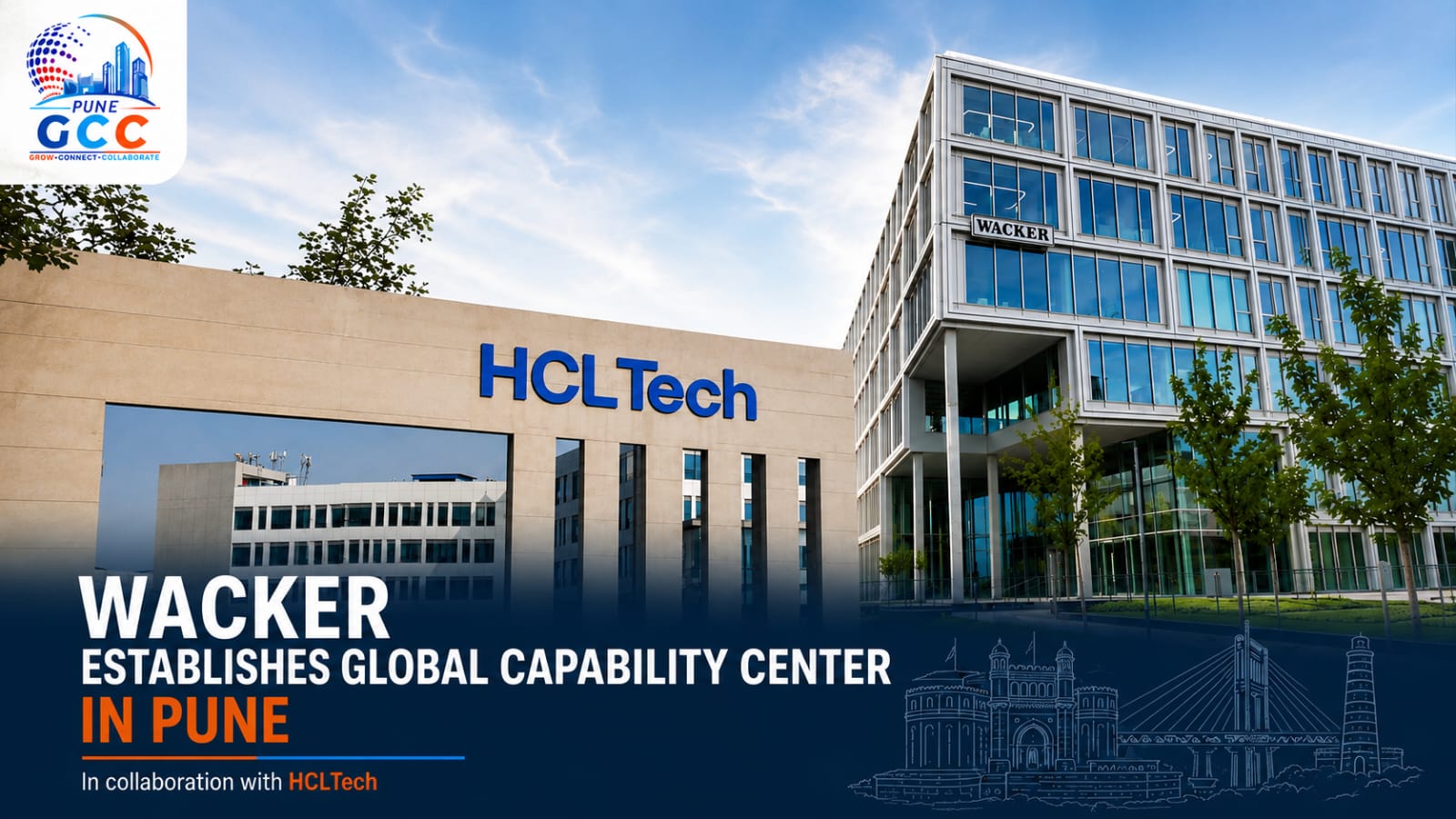
    German chemicals and biotechnology major WACKER Chemie AG has established a new Global Capability Center (GCC) in Pune in collaboration with HCLTech, further strengthening Pune’s position as a major hub for global technology, engineering and digital operations.

    The new center is being established to support WACKER’s global engineering, IT and digital transformation initiatives. The Pune GCC will provide the company with a flexible and scalable delivery foundation while strengthening its ability to execute technology-led transformation programs across its global operations.

    As part of the collaboration, HCLTech will leverage its capabilities in DevSecOps, automation and digital engineering to help WACKER build a high-performing technology team and establish strong operational and governance frameworks. The partnership is expected to support greater agility, operational efficiency and faster execution of WACKER’s digital modernization initiatives.

    The establishment of the Pune center reflects WACKER’s continued focus on strengthening its global technology capabilities and creating a more resilient operating model. By combining WACKER’s industry expertise with HCLTech’s technology capabilities, the new GCC is positioned to support the company’s evolving digital requirements and long-term growth.

    Pune has emerged as one of India’s leading destinations for Global Capability Centres, supported by its strong pool of engineering and technology talent, established industrial ecosystem and growing presence of multinational companies. WACKER’s decision to establish its GCC in the city adds another prominent global organization to Pune’s expanding GCC landscape.

    The development also highlights the increasing role of Pune-based GCCs in supporting global engineering, technology, automation and digital transformation functions, moving beyond traditional IT service delivery toward strategic global capabilities.

    With WACKER’s new center, Pune continues to attract global organizations looking to build specialized technology and engineering capabilities in India, reinforcing the city’s growing importance in the country’s GCC ecosystem.

  • Generac Business and Technology Center Inaugurated in Pune

    Generac Business and Technology Center Inaugurated in Pune

    Pune, India — August 2026: Generac has officially celebrated the ribbon-cutting of its Business and Technology Center in Pune, marking an important milestone in the company’s presence in the city and its global capability journey.

    The inauguration ceremony was held on August 11 and brought together senior Generac leadership, including Rhonda Matschke, EVP, HR; Tim Hearden, Chief Operations Officer; Amit Dogra, VP HR and Service Delivery; Christopher Jones, VP Infrastructure Operations and Enterprise Architecture; Rohit Vaidya, VP Engineering; and Joe Folk, VP Engineering. The occasion was also attended by the founding employees who have been part of building the Pune center from day one.

    Since opening in May, the Pune center has grown into a capability hub supporting Generac’s global operations across engineering, product development, IT, data analysis, reporting and transaction processing. The center is creating greater capacity for Generac’s teams worldwide to innovate and deliver value to customers.

    The establishment of the center in Pune also reflects the city’s growing importance as a global capability hub. Pune has one of the most established GCC ecosystems, providing companies with an environment to build long-term capabilities, access skilled talent and develop centers focused on technology, engineering and innovation.

    For Generac, the Pune center represents an opportunity to build a lasting center of capability and innovation while contributing to the company’s global operations.

    The ribbon-cutting marks a significant beginning for the team in Pune as it continues to expand its capabilities and support Generac’s global business. With its growing presence in the city, the center is set to become an important part of Generac’s global capability network.

  • SKF Inaugurates New Global Capability Centre in Pune

    SKF Inaugurates New Global Capability Centre in Pune

    Pune, India: SKF has inaugurated its new Global Capability Centre (GCC) in Pune, marking a significant milestone in the company’s global operations and capability expansion in India.

    The new facility is designed to strengthen operational excellence, engineering innovation and strategic global support, further enhancing SKF’s ability to build world-class capabilities from Pune.

    The inauguration was marked by a traditional lamp-lighting ceremony and a town hall attended by SKF’s senior leadership team and employees. The event celebrated the successful transition to the new facility and the collective efforts behind its establishment.

    The new Pune GCC is expected to serve as an important hub for collaboration, innovation and global support, reinforcing Pune’s position as a leading destination for Global Capability Centres.

    SKF thanked its leadership team, transition units and employees for their contribution in making the new facility a reality.

  • Leidos Opens New Office in Pune, Strengthening Its India Growth Journey

    Leidos Opens New Office in Pune, Strengthening Its India Growth Journey

    Pune, India: Virginia, U.S.-based defence and space technology company Leidos is expanding its presence in India with a new workplace in Pune, marking another significant step in the company’s growth journey in the country.

    The development was highlighted during a recent visit by Bill Johnson, Senior Vice President at Leidos, and Jessica Bryden, HR Director, to the company’s India operations. The leadership team interacted with employees and shared insights into Leidos’ future vision, growth plans in India and its expanding workplace presence in Pune.

    The new Pune office is expected to support Leidos’ continued growth in India while providing an environment for teams to collaborate, innovate and contribute to the company’s global operations.

    The leadership visit also brought together key members of the India team, including Anjan Ghosh, Sharad Jha and Shruti Rao, whose continued support and leadership have contributed to the company’s growth journey.

    The visit included team interactions, dinner and engagement activities, providing an opportunity for employees and leadership to connect beyond the workplace and strengthen team engagement.

    With the new Pune workplace and continued investment in its India operations, Leidos is strengthening its footprint in one of India’s leading technology and engineering hubs.

    For Pune’s growing GCC ecosystem, Leidos’ expansion adds another global technology and engineering organisation to the city’s increasingly diverse international business landscape. The company’s presence further highlights Pune’s role as a destination for global organisations seeking engineering, technology and specialised talent.

  • Maharashtra Issues Operational Guidelines for GCC Policy 2025: A Major Boost for Pune’s Global Tech and Engineering Hub

    Maharashtra Issues Operational Guidelines for GCC Policy 2025: A Major Boost for Pune’s Global Tech and Engineering Hub

    PUNE — In a major move aimed at cementing the state’s position as a premier global corporate destination, the Government of Maharashtra has officially issued the detailed operational guidelines for the Maharashtra Global Capability Centre (GCC) Policy 2025. Notified by the State Industries Department on August 19, 2026, these comprehensive guidelines establish the actionable framework for the policy originally announced in November 2025, which targets the setup of over 400 new GCCs and the creation of four lakh high-skilled jobs across the state.

    The release of the operational guidelines marks a critical transition from policy vision to administrative execution. The document lays down precise criteria for eligibility, investment classifications, Letter of Intent (LOI) processing, Registration Certificates (RC), incentive disbursement mechanisms, and multi-year compliance protocols.

    Under the newly released operational blueprint, the state has categorized regions into two distinct operational tiers: Zone I, comprising the Pune Metropolitan Region (PMR) and the Mumbai Metropolitan Region (MMR), and Zone II, covering the rest of Maharashtra.

    With its mature information technology corridor, established automotive and manufacturing base, premier academic institutions, and growing Grade A commercial office stock, Pune stands as a central pillar of the state’s GCC expansion strategy. The guidelines specifically tailor incentives to propel Pune from conventional shared-service operations into high-value, knowledge-intensive domains such as artificial intelligence, advanced analytics, engineering research and development (ER&D), product design, treasury management, and specialized global Centres of Excellence (CoEs).

    The operational guidelines clearly delineate who can qualify for state incentives. A GCC is defined as a fully owned, integrated captive centre set up by a multinational corporation or an Indian global conglomerate to deliver specialized, strategic capabilities solely to its parent organization and group entities.

    Eligible operations include information technology, software development, R&D, product engineering, financial controls, risk and compliance, global supply chain management, and talent architecture. To maintain a strict focus on high-value operations, the state has expressly excluded third-party business process outsourcing (BPO) operations, customer support call centres catering to external clients, and pure-play sales or trading entities from qualifying for GCC incentives.

    To accommodate operations of varying scale, the state has laid out a five-tier classification structure. Entities can qualify under either the Fixed Capital Investment (FCI) route or through direct employment thresholds, with the eligible investment window recognized from April 1, 2025 onward:

    • Small GCC: Requires a Fixed Capital Investment between ₹50 crore and less than ₹100 crore, or direct employment of 100 to less than 250 personnel.
    • Medium GCC: Requires an FCI between ₹100 crore and less than ₹250 crore, or direct employment of 250 to less than 500 personnel.
    • Large GCC: Requires an FCI between ₹250 crore and less than ₹500 crore, or direct employment of 500 to less than 750 personnel.
    • Mega GCC: Requires an FCI between ₹500 crore and less than ₹750 crore, or direct employment of 750 to less than 1,000 personnel.
    • Ultra-Mega GCC: Involves an FCI of ₹750 crore and above, or direct employment exceeding 1,000 personnel.

    The guidelines also draw a firm boundary between new setups and ongoing expansion projects. Setting up a new GCC requires dedicated, separate premises; simple internal relocations or seating additions within an existing facility do not qualify as a new establishment. For existing GCCs in Pune seeking expansion incentives, the guidelines mandate a minimum 25% increase in Gross Fixed Capital Investment alongside a 25% net addition in non-supervisory permanent headcount.

    The guidelines outline a robust package of financial benefits structured to lower capital expenditure and operational costs for companies establishing or expanding their footprints in Pune:

    • Capital Subsidy or Rental Support: Qualifying GCCs investing in eligible plant and machinery after April 1, 2025, can claim a capital subsidy of up to 20%. The subsidy is capped at ₹10 crore for Small GCCs, ₹20 crore for Medium, ₹50 crore for Large, and ₹100 crore for Mega GCCs (with customized packages available for Ultra-Mega projects), disbursed in five equal annual tranches. Alternatively, new GCCs in Pune (Zone I) can opt for rental assistance set at 10% of eligible actual rent or Ready Reckoner rates (whichever is lower), with annual caps ranging from ₹1 crore to ₹4 crore.
    • Payroll Assistance: Eligible GCCs in Zone I can avail a payroll subsidy equivalent to 40% of the salary component exceeding ₹1 lakh per month, capped at ₹50,000 per employee monthly for up to three years. GCCs meeting prescribed diversity hiring targets receive an additional 10% incentive top-up.
    • Stamp Duty and Real Estate Exemptions: The policy grants a 100% stamp duty exemption on purchasing land or built premises for setting up or expanding a GCC. Furthermore, units operating in eligible private IT parks in Zone I receive a 50% concession, while those in eligible public IT parks receive a 75% waiver, and units in SEZ/STPI zones receive full 100% exemptions.
    • Utility Subsidies: GCCs in Pune will receive a power tariff subsidy of ₹1 per unit for five years, capped at ₹20 lakh annually per centre, alongside a 10-year exemption from state electricity duty as per applicable statutory notifications.
    • R&D, Patents, and Green Buildings: To stimulate local innovation, the government will reimburse 25% of eligible R&D operating expenses up to ₹50 lakh per year for four years (maximum ₹2 crore per GCC). Projects conducted in joint collaboration with recognized universities in Maharashtra are eligible for an additional 10% subsidy. The state also covers 50% of filing expenses for domestic and international patents and offers financial incentives for LEED, IGBC, and GRIHA green building certifications.

    The operational guidelines establish a single-window workflow ensuring transparency and structured verification:

    1. Submission and approval of the initial Letter of Intent (LOI), valid for three years for Small, Medium, and Large GCCs, and five years for Mega and Ultra-Mega categories.
    2. Setup and commercial commissioning of the facility.
    3. Issuance of the Registration Certificate (RC), valid for three years and subject to periodic renewal.
    4. Evaluation and issuance of the Incentive Eligibility Letter, followed by formal claims processing, sanction, and treasury disbursement.

    To ensure long-term economic commitment, beneficiaries must remain active for a mandatory 10-year operative period starting from the date of the first Registration Certificate. Beneficiary companies must submit annual operational and statutory compliance filings. The guidelines explicitly empower authorities to revoke certificates and initiate full recovery of disbursed incentives if any enterprise submits fraudulent documentation, conceals material facts, or defaults on ongoing employment and investment conditions.

    The operationalization of Maharashtra’s GCC policy is set to generate substantial downstream momentum across Pune’s corporate ecosystem. Beyond immediate tech hiring, the policy’s clarity is expected to accelerate absorption rates for Grade A commercial real estate across key submarkets such as Hinjawadi, Kharadi, Baner, Balewadi, and Magarpatta.

    With multinational enterprises increasingly seeking advanced engineering, software architecture, and strategic leadership talent, the operational guidelines position Pune not merely as an offshore back-office location, but as an indispensable, high-value node in global enterprise operations.

  • SBI’s ₹414 Crore Kharadi Acquisition Strengthens Pune’s Corporate Real Estate Story

    SBI’s ₹414 Crore Kharadi Acquisition Strengthens Pune’s Corporate Real Estate Story

    Pune: Pune’s Kharadi continues to emerge as one of the city’s most important corporate and technology destinations, with another major commercial real estate transaction highlighting the area’s growing significance.

    State Bank of India (SBI) has acquired more than 2 acres of land along with 1.83 lakh sq. ft. of office space spread across 15 floors in Kharadi for ₹414 crore, according to a report by Hindustan Times.

    The property, located in Kharadi Knowledge Park, adds to the growing portfolio of large-scale corporate infrastructure in one of Pune’s fastest-developing business districts. The transaction also reflects continued confidence in Kharadi’s commercial real estate potential, supported by its established technology ecosystem, connectivity and concentration of major businesses.

    For Pune’s growing Global Capability Center (GCC) ecosystem, developments of this scale are significant. The availability of large, high-quality office infrastructure remains an important factor for companies evaluating Pune for technology, engineering, shared services and other global operations.

    Kharadi has already established itself as a major employment and commercial hub, and continued investment in office assets is expected to further strengthen its role in Pune’s broader business ecosystem.

    As Pune continues to attract global companies and expand its GCC footprint, Kharadi remains at the center of the city’s corporate growth story.