Tag: Pune Business News

  • CALDAN Conveyor Expands Its Pune Operations with a Larger Office Space

    CALDAN Conveyor Expands Its Pune Operations with a Larger Office Space

    The expansion reflects the company’s growing business momentum, increasing order intake and commitment to strengthening its India operations.

    Pune: Denmark-based CALDAN Conveyor A/S has expanded its presence in Pune with the opening of a larger office space for its growing India team.

    The company shared glimpses of its new Pune office, highlighting the continued growth of its India operations and the increasing opportunities in its business.

    According to CALDAN, rising order intake and a growing pipeline of opportunities have created the need for a larger workspace to support its expanding team.

    The new office is designed to provide employees with more room to collaborate, innovate and support the company’s ongoing business momentum.

    The expansion marks another milestone in CALDAN India’s journey and reflects the company’s confidence in its growing operations in the Indian market.

    Strengthening Pune’s Industrial and Business Ecosystem

    CALDAN’s office expansion adds to Pune’s evolving business landscape, where international companies continue to strengthen their presence across technology, engineering, manufacturing and industrial solutions.

    As companies expand their teams and operations in the city, Pune continues to reinforce its position as an important destination for global businesses looking to build and scale their India operations.

    The development also highlights the growing confidence of international companies in Pune’s talent pool and business ecosystem.

  • Wenglor Sensoric Group Inaugurates New Branch Office at Baner High Street, Pune

    Wenglor Sensoric Group Inaugurates New Branch Office at Baner High Street, Pune

    The expansion strengthens the company’s regional presence and reinforces its commitment to business growth in Pune.

    Wenglor Sensoric Group has inaugurated its new branch office at Baner High Street, Pune, marking an important milestone in the company’s regional expansion journey. The new office is expected to strengthen its presence in the region, support business development, and create opportunities for closer engagement with customers and partners.

    The expansion is being led by Managing Director Aniket Sawant, whose vision is shaping the company’s growth strategy, with a focus on establishing the right infrastructure and building a strong, capable team in Pune.

    The inauguration ceremony was celebrated with a traditional office pooja, bringing employees together to seek blessings and mark the beginning of a new chapter for the organisation.

    The new branch office reflects Wenglor Sensoric Group’s continued focus on strengthening its regional operations and building stronger business connections.

    Pune’s growing industrial base, skilled talent pool, and expanding business ecosystem continue to make the city an attractive destination for companies looking to strengthen their presence and explore new growth opportunities.

  • TIAA Celebrates 10 Years in India, Opens New Pune Office to House 2,000 Colleagues

    TIAA Celebrates 10 Years in India, Opens New Pune Office to House 2,000 Colleagues

    Pune, Maharashtra: TIAA, a leading financial services organisation, has marked a decade of its Global Capabilities operations in India with the opening of a new office in Pune, which will serve as a workplace for approximately 2,000 colleagues. The milestone was celebrated with a series of engagements across Pune and Mumbai, bringing together global leadership, employees and teams from across the organisation.

    The celebrations were led by Thasunda Brown Duckett, President and CEO of TIAA, during her visit to India. The visit also coincided with the fifth anniversary of her leadership at the organisation. She engaged with associates, participated in town halls and met employee resource group leaders, highlighting the importance of people, collaboration and a shared sense of purpose in driving long-term progress.

    Over the past decade, TIAA Global Capabilities in India has evolved from supporting business strategy to playing a more integral role in shaping it. Its teams have taken greater ownership of products and platforms, while developing capabilities that contribute to the organisation’s broader business objectives.

    Sastry Durvasula, Chief Operating Officer at TIAA, highlighted the scale of the milestone, which included recognising 81 colleagues who have been with the organisation since its inception in India. A commemorative coffee table book documenting the journey, achievements and stories of its people was also unveiled during the celebrations.

    The week featured town halls, workplace interactions, leadership discussions and engagements with Business Resource Groups. Leaders also explored the artificial intelligence innovations and fintech capabilities being developed by teams in India, reflecting the country’s growing contribution to enterprise-wide innovation and technology.

    Deepak Gupta, Executive Vice President and Head of TIAA Global Capabilities, described the milestone as a celebration of the people who have shaped the organisation’s journey in India. He emphasised the contributions of early team members, the leadership team’s continued support and the commitment of associates across Pune and Mumbai.

    The opening of the new Pune office further reinforces the city’s position as an important destination for global capability centre (GCC) operations. With its expanding talent pool, technology ecosystem and established business infrastructure, Pune continues to attract multinational organisations looking to strengthen their global operations and build advanced capabilities.

    As TIAA enters its next decade in India, its expanding presence in Pune underscores the growing role of Indian GCCs in enterprise strategy, technology development and innovation.

  • Pramod Mankar Joins Q4 as GCC Engineering Leader

    Pramod Mankar Joins Q4 as GCC Engineering Leader

    Pune GCC | Leadership & Appointments

    Pramod Mankar has joined Q4 as GCC Engineering Leader, where he will lead India Product Engineering and software delivery for the company’s investor relations technology platform.

    In his new role, Mankar will focus on establishing Q4’s India Engineering Organisation, building scalable and reliable products, strengthening engineering execution, and driving platform modernisation. He will also work with cross-functional teams to deliver customer-centric solutions and business value for customers across global capital markets. His responsibilities include supporting products such as Studio, CES and Q4’s digital investor engagement solutions.

    Q4 Inc. is a financial technology company headquartered in Toronto, Canada, specialising in investor relations technology. Its platform helps publicly traded companies manage investor communications, digital investor websites, earnings events, investor engagement and shareholder intelligence. Q4’s solutions enable investor relations teams to strengthen relationships with the investment community and make informed, data-driven decisions.

    Mankar’s appointment reflects the growing importance of India-based engineering teams in developing and scaling technology platforms for global markets. Through the establishment of its India Engineering Organisation, Q4 will strengthen its product engineering and software delivery capabilities to support its global customer base.

    Pune GCC congratulates Pramod Mankar on his new role and wishes him success in this new professional chapter.

  • Orbia Appoints Bijal Shah as Head of Its Global Capability Centre in Pune

    Orbia Appoints Bijal Shah as Head of Its Global Capability Centre in Pune

    Pune, Maharashtra: Orbia has appointed Bijal Shah as the new Head of its Global Capability Centre (GCC) in Pune. With more than 23 years of global leadership experience spanning technology, operations, financial services and capability centres, Shah will lead the centre into its next phase of growth.

    Before joining Orbia, Shah served as India Country Head and Board Director at Genworth Financial, where she played a role in strengthening organisational capabilities and enabling enterprise-wide transformation.

    At Orbia, Shah will focus on building high-performing teams, advancing innovation, driving operational excellence and strengthening partnerships across the organisation’s global operations. Her appointment comes as global capability centres continue to expand their strategic role, moving beyond traditional support functions to contribute to business transformation and innovation.

    Pune has emerged as an important destination for GCCs, supported by its established technology ecosystem, skilled talent pool and growing presence of multinational organisations. Leadership appointments such as Shah’s further highlight the city’s evolving role in global business operations.

    Orbia’s Pune GCC is positioned to contribute to the organisation’s global priorities by strengthening capabilities, enabling collaboration and delivering meaningful business impact.

  • US-Based BrightNight Inaugurates Another New Office in Pune

    US-Based BrightNight Inaugurates Another New Office in Pune

    US-based AI-native power company BrightNight has inaugurated its new office in Pune, marking another addition to the city’s growing GCC ecosystem. The expansion reflects the company’s long-term commitment to India and its plans to build a larger presence in the country.

    The new office marks an important step in BrightNight’s India growth journey. The company currently has around 58 employees in India and plans to significantly expand its workforce, with several new positions opening as part of this expansion.

    BrightNight describes itself as the first purpose-built independent power company designed to deliver safe, reliable, dispatchable, highest-value energy at the lowest cost to the fastest-growing markets. The company primarily serves utilities, data centers, and commercial & industrial (C&I) customers.

    Speaking at the inauguration, Founder & CEO Martin Hermann said:

    “The inauguration of our new Pune office reflects both how far BrightNight has come and the ambition we have for the future. India is home to exceptional talent, and our growing Pune team will play an important role in advancing innovation, collaboration, and execution excellence behind our mission to deliver next-generation power and digital infrastructure. We are proud to deepen our commitment to Pune and excited to build the next chapter of BrightNight’s growth together.”

    Head of BrightNight India, Sitesh Subudhi, said:

    “Our new Pune office marks an important milestone in BrightNight’s growth and reflects our long-term commitment to the region. As we continue to expand our capabilities and invest in our people, this office will provide a best-in-class environment for talent, innovation, collaboration, and operational excellence. It strengthens our ability to scale while building a sustainable foundation for BrightNight’s continued growth in India.”

    BrightNight’s expansion comes at a time when Pune continues to attract global companies across technology, engineering, energy, and digital infrastructure. With plans to grow its workforce and invest in local talent, the company further strengthens Pune’s position as one of India’s leading destinations for global capability centres and innovation-driven operations.

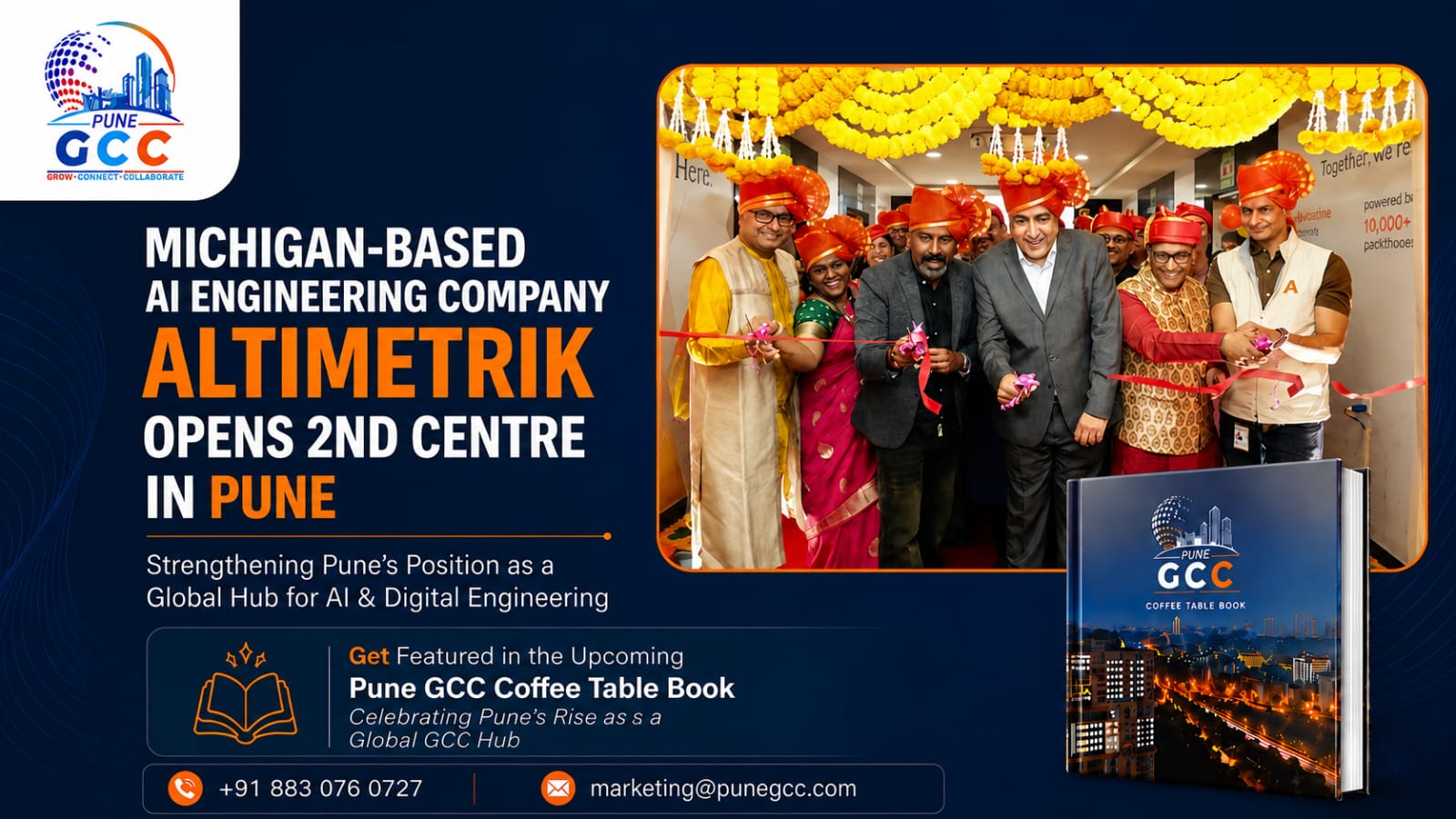
  • Michigan-Based AI Engineering Company Altimetrik Opens Its Second Centre in Pune

    Michigan-Based AI Engineering Company Altimetrik Opens Its Second Centre in Pune

    Pune: Pune’s position as a leading destination for artificial intelligence, digital engineering and Global Capability Centre (GCC) operations continues to strengthen as Altimetrik, a Michigan-based AI engineering company, expands its footprint in the city with the opening of its second centre in Pune.

    Headquartered in Southfield, Michigan, Altimetrik is an AI-native digital engineering company that works with global enterprises to accelerate digital transformation, modernise technology platforms and develop AI-powered solutions.

    The company’s expansion in Pune highlights the growing importance of the city within its global engineering and technology operations. With enterprises increasingly investing in Artificial Intelligence, Generative AI, data engineering, cloud technologies, digital platforms and automation, Pune has emerged as a strategic location for companies building advanced technology and engineering capabilities.

    Altimetrik has been expanding its focus on enterprise AI as organisations move beyond experimentation towards deploying AI solutions at scale. The company has developed capabilities across AI engineering, data and analytics, cloud, product engineering and digital transformation, supporting enterprises across multiple industries.

    The company has also been strengthening its AI ecosystem through partnerships with leading technology companies, including OpenAI, Google Cloud, Anthropic, Snowflake and Databricks. Its AI-focused initiatives are aimed at helping organisations accelerate the adoption of AI and integrate intelligent technologies into their core business operations.

    Altimetrik was recently named an OpenAI Advanced Partner, reflecting its growing focus on enterprise AI engineering and the deployment of AI solutions in production environments.

    Pune Strengthens Its Position as an AI and Engineering Hub

    The opening of Altimetrik’s second centre adds to the growing list of global technology companies expanding their engineering, technology and innovation operations in Pune.

    The city has established itself as one of India’s leading technology ecosystems, supported by a strong talent pool, established IT infrastructure, a large presence of multinational corporations and a rapidly expanding GCC ecosystem.

    Pune is increasingly attracting organisations looking to establish or expand centres focused not only on traditional IT services but also on AI engineering, software product development, cybersecurity, data science, cloud computing, digital transformation and global R&D.

    Altimetrik’s latest expansion is therefore significant in the broader context of Pune’s GCC growth. The company’s focus on AI and digital engineering aligns closely with the changing nature of GCCs in the city, where global organisations are increasingly moving towards higher-value technology, innovation and product-led functions.

    Growing Global Technology Footprint

    Altimetrik’s second Pune centre is expected to further support its engineering and technology capabilities while strengthening its ability to serve global customers from India.

    The expansion also reflects the continued confidence of international technology companies in Pune as a location for building specialised technology teams and accessing skilled engineering talent.

    As global enterprises accelerate their investments in AI and digital transformation, Pune is increasingly positioning itself as a key global hub for AI engineering, technology innovation and next-generation GCC operations.

    The latest expansion by Altimetrik adds another major technology company to Pune’s growing ecosystem and further reinforces the city’s emergence as an important destination for global engineering and innovation.

    Pune GCC will continue to track major GCC expansions, investments, leadership developments and technology announcements shaping Pune’s global capability ecosystem.

  • Maharashtra Issues Operational Guidelines for GCC Policy 2025: A Major Boost for Pune’s Global Tech and Engineering Hub

    Maharashtra Issues Operational Guidelines for GCC Policy 2025: A Major Boost for Pune’s Global Tech and Engineering Hub

    PUNE — In a major move aimed at cementing the state’s position as a premier global corporate destination, the Government of Maharashtra has officially issued the detailed operational guidelines for the Maharashtra Global Capability Centre (GCC) Policy 2025. Notified by the State Industries Department on August 19, 2026, these comprehensive guidelines establish the actionable framework for the policy originally announced in November 2025, which targets the setup of over 400 new GCCs and the creation of four lakh high-skilled jobs across the state.

    The release of the operational guidelines marks a critical transition from policy vision to administrative execution. The document lays down precise criteria for eligibility, investment classifications, Letter of Intent (LOI) processing, Registration Certificates (RC), incentive disbursement mechanisms, and multi-year compliance protocols.

    Under the newly released operational blueprint, the state has categorized regions into two distinct operational tiers: Zone I, comprising the Pune Metropolitan Region (PMR) and the Mumbai Metropolitan Region (MMR), and Zone II, covering the rest of Maharashtra.

    With its mature information technology corridor, established automotive and manufacturing base, premier academic institutions, and growing Grade A commercial office stock, Pune stands as a central pillar of the state’s GCC expansion strategy. The guidelines specifically tailor incentives to propel Pune from conventional shared-service operations into high-value, knowledge-intensive domains such as artificial intelligence, advanced analytics, engineering research and development (ER&D), product design, treasury management, and specialized global Centres of Excellence (CoEs).

    The operational guidelines clearly delineate who can qualify for state incentives. A GCC is defined as a fully owned, integrated captive centre set up by a multinational corporation or an Indian global conglomerate to deliver specialized, strategic capabilities solely to its parent organization and group entities.

    Eligible operations include information technology, software development, R&D, product engineering, financial controls, risk and compliance, global supply chain management, and talent architecture. To maintain a strict focus on high-value operations, the state has expressly excluded third-party business process outsourcing (BPO) operations, customer support call centres catering to external clients, and pure-play sales or trading entities from qualifying for GCC incentives.

    To accommodate operations of varying scale, the state has laid out a five-tier classification structure. Entities can qualify under either the Fixed Capital Investment (FCI) route or through direct employment thresholds, with the eligible investment window recognized from April 1, 2025 onward:

    • Small GCC: Requires a Fixed Capital Investment between ₹50 crore and less than ₹100 crore, or direct employment of 100 to less than 250 personnel.
    • Medium GCC: Requires an FCI between ₹100 crore and less than ₹250 crore, or direct employment of 250 to less than 500 personnel.
    • Large GCC: Requires an FCI between ₹250 crore and less than ₹500 crore, or direct employment of 500 to less than 750 personnel.
    • Mega GCC: Requires an FCI between ₹500 crore and less than ₹750 crore, or direct employment of 750 to less than 1,000 personnel.
    • Ultra-Mega GCC: Involves an FCI of ₹750 crore and above, or direct employment exceeding 1,000 personnel.

    The guidelines also draw a firm boundary between new setups and ongoing expansion projects. Setting up a new GCC requires dedicated, separate premises; simple internal relocations or seating additions within an existing facility do not qualify as a new establishment. For existing GCCs in Pune seeking expansion incentives, the guidelines mandate a minimum 25% increase in Gross Fixed Capital Investment alongside a 25% net addition in non-supervisory permanent headcount.

    The guidelines outline a robust package of financial benefits structured to lower capital expenditure and operational costs for companies establishing or expanding their footprints in Pune:

    • Capital Subsidy or Rental Support: Qualifying GCCs investing in eligible plant and machinery after April 1, 2025, can claim a capital subsidy of up to 20%. The subsidy is capped at ₹10 crore for Small GCCs, ₹20 crore for Medium, ₹50 crore for Large, and ₹100 crore for Mega GCCs (with customized packages available for Ultra-Mega projects), disbursed in five equal annual tranches. Alternatively, new GCCs in Pune (Zone I) can opt for rental assistance set at 10% of eligible actual rent or Ready Reckoner rates (whichever is lower), with annual caps ranging from ₹1 crore to ₹4 crore.
    • Payroll Assistance: Eligible GCCs in Zone I can avail a payroll subsidy equivalent to 40% of the salary component exceeding ₹1 lakh per month, capped at ₹50,000 per employee monthly for up to three years. GCCs meeting prescribed diversity hiring targets receive an additional 10% incentive top-up.
    • Stamp Duty and Real Estate Exemptions: The policy grants a 100% stamp duty exemption on purchasing land or built premises for setting up or expanding a GCC. Furthermore, units operating in eligible private IT parks in Zone I receive a 50% concession, while those in eligible public IT parks receive a 75% waiver, and units in SEZ/STPI zones receive full 100% exemptions.
    • Utility Subsidies: GCCs in Pune will receive a power tariff subsidy of ₹1 per unit for five years, capped at ₹20 lakh annually per centre, alongside a 10-year exemption from state electricity duty as per applicable statutory notifications.
    • R&D, Patents, and Green Buildings: To stimulate local innovation, the government will reimburse 25% of eligible R&D operating expenses up to ₹50 lakh per year for four years (maximum ₹2 crore per GCC). Projects conducted in joint collaboration with recognized universities in Maharashtra are eligible for an additional 10% subsidy. The state also covers 50% of filing expenses for domestic and international patents and offers financial incentives for LEED, IGBC, and GRIHA green building certifications.

    The operational guidelines establish a single-window workflow ensuring transparency and structured verification:

    1. Submission and approval of the initial Letter of Intent (LOI), valid for three years for Small, Medium, and Large GCCs, and five years for Mega and Ultra-Mega categories.
    2. Setup and commercial commissioning of the facility.
    3. Issuance of the Registration Certificate (RC), valid for three years and subject to periodic renewal.
    4. Evaluation and issuance of the Incentive Eligibility Letter, followed by formal claims processing, sanction, and treasury disbursement.

    To ensure long-term economic commitment, beneficiaries must remain active for a mandatory 10-year operative period starting from the date of the first Registration Certificate. Beneficiary companies must submit annual operational and statutory compliance filings. The guidelines explicitly empower authorities to revoke certificates and initiate full recovery of disbursed incentives if any enterprise submits fraudulent documentation, conceals material facts, or defaults on ongoing employment and investment conditions.

    The operationalization of Maharashtra’s GCC policy is set to generate substantial downstream momentum across Pune’s corporate ecosystem. Beyond immediate tech hiring, the policy’s clarity is expected to accelerate absorption rates for Grade A commercial real estate across key submarkets such as Hinjawadi, Kharadi, Baner, Balewadi, and Magarpatta.

    With multinational enterprises increasingly seeking advanced engineering, software architecture, and strategic leadership talent, the operational guidelines position Pune not merely as an offshore back-office location, but as an indispensable, high-value node in global enterprise operations.