Pune: The Pune Economic Region is set for an ambitious decade of economic and infrastructure expansion under a comprehensive roadmap prepared through NITI Aayog’s Growth Hub initiative.
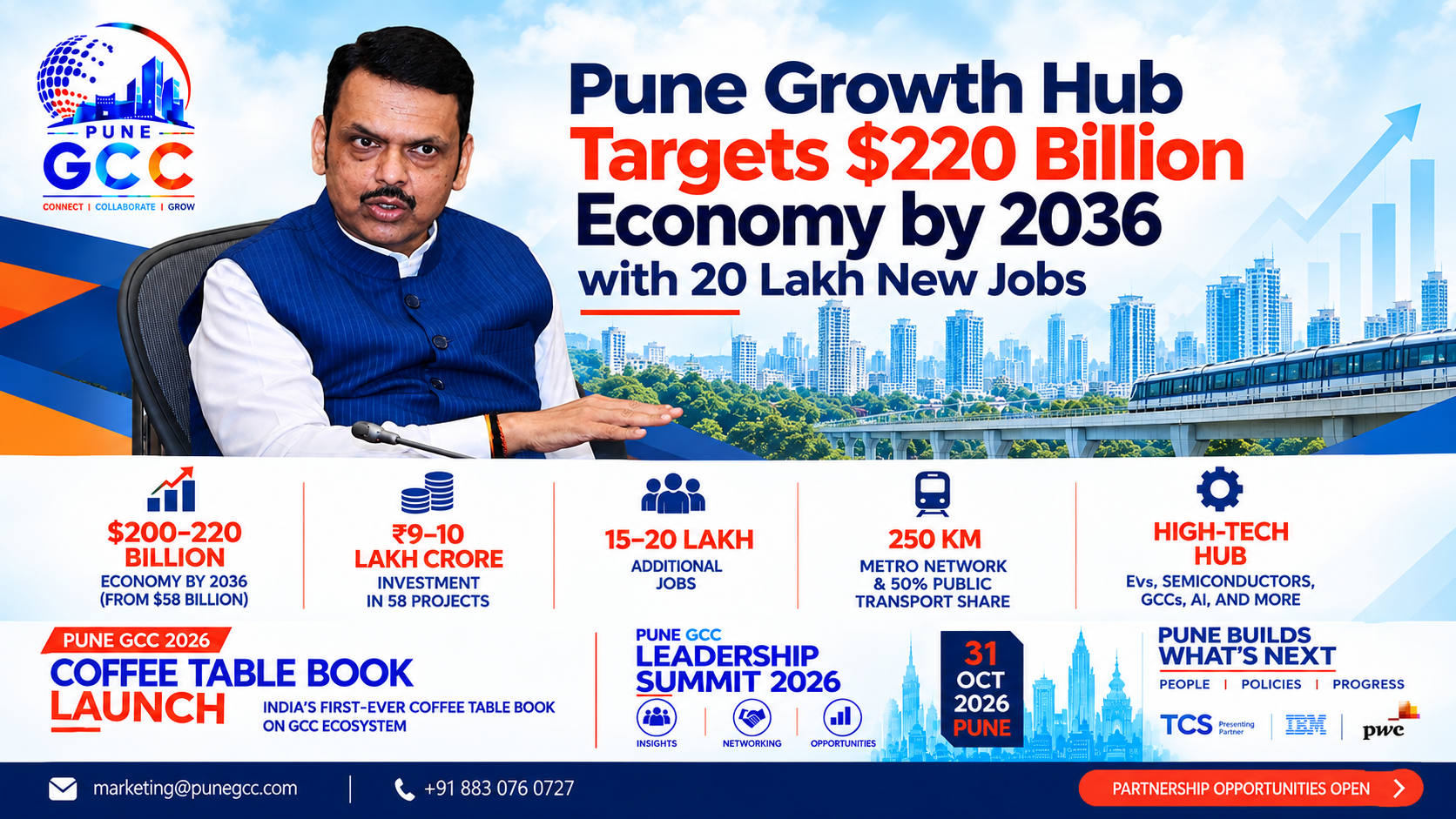
The master plan, presented to Maharashtra Chief Minister Devendra Fadnavis at a high-level meeting at Sahyadri Guest House, proposes expanding the region’s economy from approximately $68 billion in FY 2025–26 to $200–220 billion by FY 2035–36.
The roadmap identifies 58 priority projects, requiring an estimated ₹9–10 lakh crore in investment, with a target of creating 15–20 lakh additional jobs over the next decade.
The plan covers the Pune Municipal Corporation (PMC), Pimpri-Chinchwad Municipal Corporation (PCMC) and Pune Metropolitan Region Development Authority (PMRDA) areas. The planning process began in August 2025 and involved NITI Aayog, the Government of Maharashtra and the Pune International Centre, with consultations involving citizens, industry and educational institutions.
Targeting 10% Annual Real Economic Growth
The Pune Economic Region currently contributes approximately 11–12% of Maharashtra’s overall income, while its real economic growth rate is estimated at around 6–6.5%.
The Growth Hub roadmap proposes accelerating this rate to approximately 10% annually, supporting Maharashtra’s broader ambition of becoming a $5 trillion economy by 2047.
With a population of around 15 million, the Pune Economic Region is being positioned for growth that combines industrial expansion, technology, infrastructure, housing, tourism and environmental sustainability.
Six Core Sectors for Pune’s Next Growth Phase
A major focus of the roadmap is the development of advanced manufacturing and technology-driven industries.
The identified growth areas include:
- Automotive and electric vehicles
- Engineering goods and precision manufacturing
- Defence technology
- Robotics and drones
- Electronics and semiconductors
- Information technology, Global Capability Centres and artificial intelligence
- Biotechnology and life sciences
The roadmap proposes initiatives such as EV and future-mobility hubs, high-tech engineering parks, defence technology facilities, robotics centres, electronics and semiconductor manufacturing, IT facilities, GCCs and AI hubs.
These high-technology sectors are expected to have the potential to generate 4–5 lakh additional jobs.
For Pune’s growing GCC ecosystem, the emphasis on Global Capability Centres, AI, advanced engineering, electronics, semiconductors and high-tech manufacturing could create additional opportunities for global companies establishing or expanding operations in the region.
15–20 Lakh Additional Jobs
Employment generation is one of the central objectives of the Growth Hub roadmap.
Pune currently has approximately 56 lakh jobs, while the plan envisages total employment increasing to around 74–76 lakh over the next decade.
The additional employment opportunities are expected to emerge across manufacturing, technology, services, healthcare, education, tourism, agriculture, food processing, logistics and related sectors.
The roadmap also proposes expanding the startup ecosystem to more than 10,000 active ventures and reskilling 1.5–2 lakh technology professionals in areas including AI, cloud computing and cybersecurity.
250-Km Metro Network and 50% Public Transport Share
Mobility is another major pillar of the proposed transformation.
The Growth Hub plan targets increasing the share of public transport in daily travel from approximately 13% to 50%.
The proposed infrastructure expansion includes:
250 km of Metro network
12,000–14,000 city buses
11 railway projects
13 major road projects
Six multimodal transport hubs
The objective is to create a more integrated regional transport system while reducing dependence on private vehicles and improving connectivity between residential, industrial and employment centres.
Affordable Housing and Slum Rehabilitation
With employment and population expected to grow, housing has been identified as an important component of the roadmap.
The plan proposes 4–5 lakh affordable homes for different income groups, workers, students and technology professionals.
This includes approximately one lakh hostel units for industrial workers.
The roadmap also proposes cluster-based redevelopment and aims to rehabilitate around 90% of eligible slum-dwelling families by 2036.
Tourism: Positioning Pune Among India’s Top Destinations
Tourism is another major growth opportunity identified in the roadmap.
The plan proposes developing multiple tourism segments, including heritage, adventure, wellness, events, wildlife and religious tourism.
Among the proposals are a Chhatrapati Shivaji Maharaj Fort Circuit connecting Shivneri, Lohagad, Rajgad and Sinhagad; water tourism hubs around Pawna and Bhatghar; a 600-km Sahyadri trekking trail; a Junnar leopard safari; wellness and medical tourism initiatives; and event and entertainment infrastructure around the Pune International Exhibition and Convention Centre.
The broader objective is to position the Pune Economic Region among India’s top 10 tourism destinations.
Agriculture and Food Processing
The roadmap also looks beyond Pune’s urban economy, with agriculture and food processing identified as important drivers for the region’s rural belts.
The plan targets increasing the combined Gross Value Added from agriculture and food processing from approximately $5 billion to $10–12 billion.
Priority areas include horticulture, dairy, food processing, cold storage and cold-chain infrastructure, with products such as grapes, bananas, pomegranates, figs and strawberries identified as opportunities. Biofuel-related initiatives are also proposed.
Water Security for a Growing Region
The roadmap estimates that the Pune Economic Region could require an additional 200 million litres of water per day as population and economic activity expand.
Proposed measures include additional water allocation, supplies from the Bhama basin, wastewater reuse, improved distribution efficiency and desilting of water-storage infrastructure.
The objective is to strengthen water security alongside long-term urban and industrial expansion.
Skills, Startups and Future Workforce
The proposed economic transformation is accompanied by a strong focus on skills.
Training and reskilling initiatives are expected to focus on areas such as electric vehicles, electronics, robotics, biotechnology, artificial intelligence, cloud computing and cybersecurity.
The roadmap also places emphasis on increasing workforce participation and creating opportunities for young people and women.
Governance and Implementation Framework
To coordinate the implementation of the Growth Hub roadmap, a multi-level governance structure has been proposed.
The framework includes a Governing Council chaired by the Chief Minister, a State Steering Committee headed by the Chief Secretary, a Pune Growth Hub Steering Committee, and a Project Management Unit associated with PMRDA.
The proposed structure is intended to coordinate multiple government departments and agencies involved in infrastructure, industry, transport, housing and other development projects.
What the Roadmap Means for Pune’s GCC Ecosystem
The proposed Growth Hub strategy has particular relevance for Pune’s rapidly developing Global Capability Centre ecosystem.
The roadmap explicitly identifies GCCs, information technology and artificial intelligence among the areas for future growth, alongside semiconductors, advanced engineering, electronics, defence technology, robotics and EVs.
As these sectors expand, Pune’s role could increasingly connect global technology operations with advanced manufacturing, engineering, R&D and innovation capabilities.
For the Pune GCC ecosystem, the next decade could therefore involve not only an increase in the number of centres, but also greater diversification into AI, engineering, product development, cybersecurity, semiconductor technology, advanced manufacturing and global R&D functions.
A Decade of Transformation Ahead
The Pune Growth Hub roadmap presents a long-term development framework built around a combination of economic growth, technology, manufacturing, employment, mobility, housing, tourism and sustainability.
Its headline targets — a $200–220 billion economy, ₹9–10 lakh crore of proposed investment, 15–20 lakh additional jobs and a 250-km Metro network by 2036 — underline the scale of the proposed transformation.
The implementation of these ambitions will depend on project execution, financing, inter-agency coordination, policy decisions and timelines adopted by the government.
For Pune, however, the roadmap provides a clear indication of the direction being proposed for the region’s next phase of growth: more technology, deeper industrial capabilities, stronger global connectivity and a larger role in Maharashtra’s economic future.
Pune GCC will continue to track developments around the Pune Growth Hub, GCC expansion, technology investments and the evolving business ecosystem across the Pune Economic Region.