Tag: Product Engineering

  • L&T Technology Services Inaugurates New Engineering Centre in Pune with 1,200+ Seats

    L&T Technology Services Inaugurates New Engineering Centre in Pune with 1,200+ Seats

    The new three-floor facility will strengthen LTTS’ engineering delivery capabilities across mobility, sustainability, digital engineering, and AI-enabled workflows.

    L&T Technology Services (LTTS) has inaugurated a new Engineering Centre in Pune, marking another investment in the city’s growing engineering and technology ecosystem.

    The facility, spanning three floors with a capacity of more than 1,200 seats, has been designed to support customer growth, multidisciplinary engineering delivery, and closer collaboration across teams.

    Supporting Advanced Engineering Capabilities

    The new Engineering Centre will bring together expertise across multiple technology and engineering domains, including core product engineering, embedded systems, automotive software, computer-aided engineering (CAE), digital engineering, product lifecycle management (PLM), validation, and AI-enabled engineering workflows.

    The centre will serve customers across Mobility, Sustainability, and Technology. Its infrastructure is designed to support dedicated engineering teams, secure development environments, and seamless collaboration across functions.

    Strengthening Pune’s Engineering Ecosystem

    The inauguration underscores Pune’s continued importance as a destination for engineering talent, technology development, and innovation-led business operations.

    With its established automotive and manufacturing base, technology expertise, and skilled workforce, Pune offers a strong ecosystem for companies developing advanced engineering solutions and serving global customers.

    LTTS’ latest investment adds to the city’s evolving engineering landscape, reinforcing Pune’s role in supporting global technology and product development initiatives.

    As businesses increasingly integrate digital engineering, embedded technologies, and artificial intelligence into their operations, investments of this nature further highlight Pune’s potential as a centre for global engineering excellence.

  • Pramod Mankar Joins Q4 as GCC Engineering Leader

    Pramod Mankar Joins Q4 as GCC Engineering Leader

    Pune GCC | Leadership & Appointments

    Pramod Mankar has joined Q4 as GCC Engineering Leader, where he will lead India Product Engineering and software delivery for the company’s investor relations technology platform.

    In his new role, Mankar will focus on establishing Q4’s India Engineering Organisation, building scalable and reliable products, strengthening engineering execution, and driving platform modernisation. He will also work with cross-functional teams to deliver customer-centric solutions and business value for customers across global capital markets. His responsibilities include supporting products such as Studio, CES and Q4’s digital investor engagement solutions.

    Q4 Inc. is a financial technology company headquartered in Toronto, Canada, specialising in investor relations technology. Its platform helps publicly traded companies manage investor communications, digital investor websites, earnings events, investor engagement and shareholder intelligence. Q4’s solutions enable investor relations teams to strengthen relationships with the investment community and make informed, data-driven decisions.

    Mankar’s appointment reflects the growing importance of India-based engineering teams in developing and scaling technology platforms for global markets. Through the establishment of its India Engineering Organisation, Q4 will strengthen its product engineering and software delivery capabilities to support its global customer base.

    Pune GCC congratulates Pramod Mankar on his new role and wishes him success in this new professional chapter.

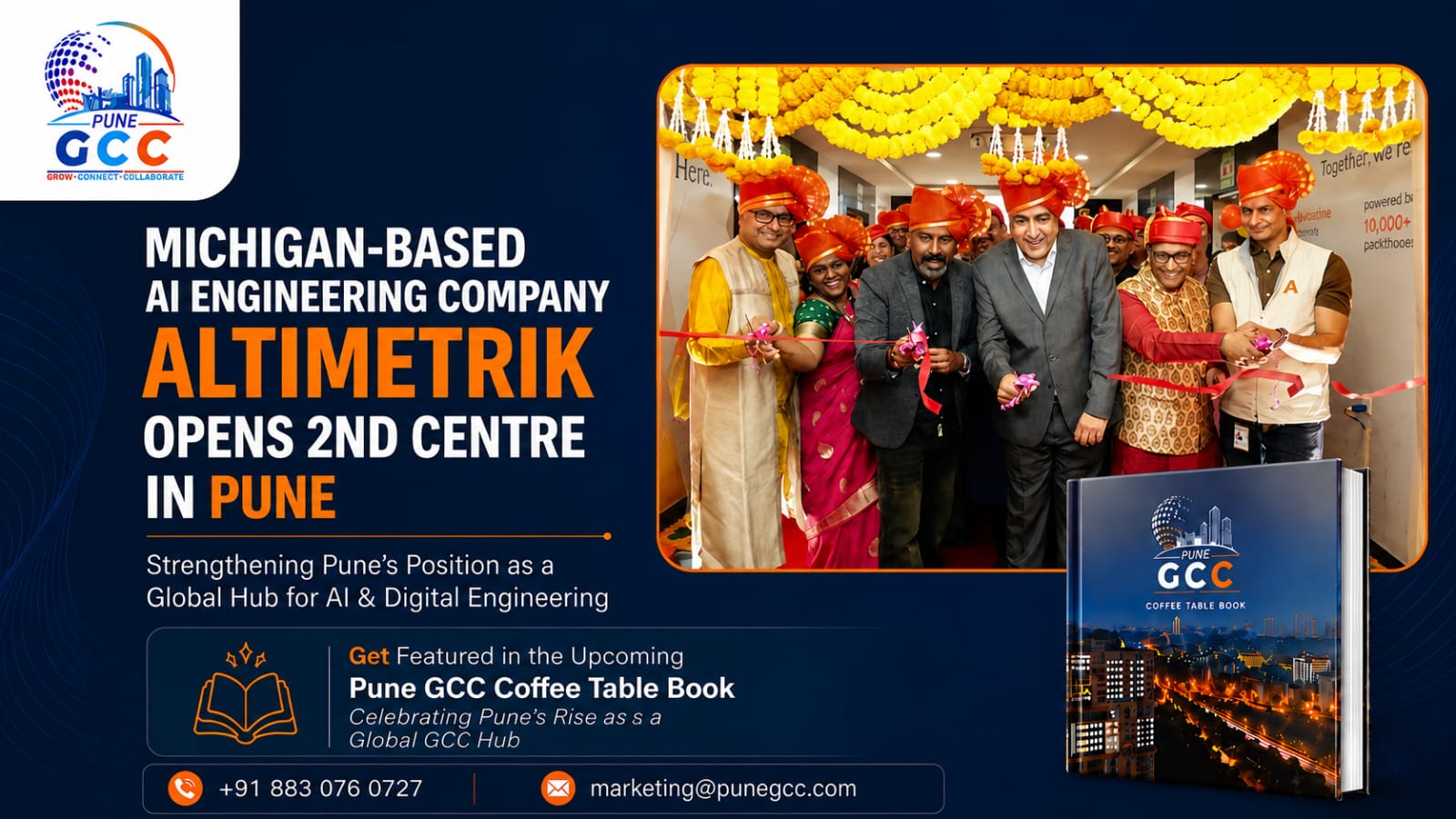
  • Michigan-Based AI Engineering Company Altimetrik Opens Its Second Centre in Pune

    Michigan-Based AI Engineering Company Altimetrik Opens Its Second Centre in Pune

    Pune: Pune’s position as a leading destination for artificial intelligence, digital engineering and Global Capability Centre (GCC) operations continues to strengthen as Altimetrik, a Michigan-based AI engineering company, expands its footprint in the city with the opening of its second centre in Pune.

    Headquartered in Southfield, Michigan, Altimetrik is an AI-native digital engineering company that works with global enterprises to accelerate digital transformation, modernise technology platforms and develop AI-powered solutions.

    The company’s expansion in Pune highlights the growing importance of the city within its global engineering and technology operations. With enterprises increasingly investing in Artificial Intelligence, Generative AI, data engineering, cloud technologies, digital platforms and automation, Pune has emerged as a strategic location for companies building advanced technology and engineering capabilities.

    Altimetrik has been expanding its focus on enterprise AI as organisations move beyond experimentation towards deploying AI solutions at scale. The company has developed capabilities across AI engineering, data and analytics, cloud, product engineering and digital transformation, supporting enterprises across multiple industries.

    The company has also been strengthening its AI ecosystem through partnerships with leading technology companies, including OpenAI, Google Cloud, Anthropic, Snowflake and Databricks. Its AI-focused initiatives are aimed at helping organisations accelerate the adoption of AI and integrate intelligent technologies into their core business operations.

    Altimetrik was recently named an OpenAI Advanced Partner, reflecting its growing focus on enterprise AI engineering and the deployment of AI solutions in production environments.

    Pune Strengthens Its Position as an AI and Engineering Hub

    The opening of Altimetrik’s second centre adds to the growing list of global technology companies expanding their engineering, technology and innovation operations in Pune.

    The city has established itself as one of India’s leading technology ecosystems, supported by a strong talent pool, established IT infrastructure, a large presence of multinational corporations and a rapidly expanding GCC ecosystem.

    Pune is increasingly attracting organisations looking to establish or expand centres focused not only on traditional IT services but also on AI engineering, software product development, cybersecurity, data science, cloud computing, digital transformation and global R&D.

    Altimetrik’s latest expansion is therefore significant in the broader context of Pune’s GCC growth. The company’s focus on AI and digital engineering aligns closely with the changing nature of GCCs in the city, where global organisations are increasingly moving towards higher-value technology, innovation and product-led functions.

    Growing Global Technology Footprint

    Altimetrik’s second Pune centre is expected to further support its engineering and technology capabilities while strengthening its ability to serve global customers from India.

    The expansion also reflects the continued confidence of international technology companies in Pune as a location for building specialised technology teams and accessing skilled engineering talent.

    As global enterprises accelerate their investments in AI and digital transformation, Pune is increasingly positioning itself as a key global hub for AI engineering, technology innovation and next-generation GCC operations.

    The latest expansion by Altimetrik adds another major technology company to Pune’s growing ecosystem and further reinforces the city’s emergence as an important destination for global engineering and innovation.

    Pune GCC will continue to track major GCC expansions, investments, leadership developments and technology announcements shaping Pune’s global capability ecosystem.

  • Maharashtra Issues Operational Guidelines for GCC Policy 2025: A Major Boost for Pune’s Global Tech and Engineering Hub

    Maharashtra Issues Operational Guidelines for GCC Policy 2025: A Major Boost for Pune’s Global Tech and Engineering Hub

    PUNE — In a major move aimed at cementing the state’s position as a premier global corporate destination, the Government of Maharashtra has officially issued the detailed operational guidelines for the Maharashtra Global Capability Centre (GCC) Policy 2025. Notified by the State Industries Department on August 19, 2026, these comprehensive guidelines establish the actionable framework for the policy originally announced in November 2025, which targets the setup of over 400 new GCCs and the creation of four lakh high-skilled jobs across the state.

    The release of the operational guidelines marks a critical transition from policy vision to administrative execution. The document lays down precise criteria for eligibility, investment classifications, Letter of Intent (LOI) processing, Registration Certificates (RC), incentive disbursement mechanisms, and multi-year compliance protocols.

    Under the newly released operational blueprint, the state has categorized regions into two distinct operational tiers: Zone I, comprising the Pune Metropolitan Region (PMR) and the Mumbai Metropolitan Region (MMR), and Zone II, covering the rest of Maharashtra.

    With its mature information technology corridor, established automotive and manufacturing base, premier academic institutions, and growing Grade A commercial office stock, Pune stands as a central pillar of the state’s GCC expansion strategy. The guidelines specifically tailor incentives to propel Pune from conventional shared-service operations into high-value, knowledge-intensive domains such as artificial intelligence, advanced analytics, engineering research and development (ER&D), product design, treasury management, and specialized global Centres of Excellence (CoEs).

    The operational guidelines clearly delineate who can qualify for state incentives. A GCC is defined as a fully owned, integrated captive centre set up by a multinational corporation or an Indian global conglomerate to deliver specialized, strategic capabilities solely to its parent organization and group entities.

    Eligible operations include information technology, software development, R&D, product engineering, financial controls, risk and compliance, global supply chain management, and talent architecture. To maintain a strict focus on high-value operations, the state has expressly excluded third-party business process outsourcing (BPO) operations, customer support call centres catering to external clients, and pure-play sales or trading entities from qualifying for GCC incentives.

    To accommodate operations of varying scale, the state has laid out a five-tier classification structure. Entities can qualify under either the Fixed Capital Investment (FCI) route or through direct employment thresholds, with the eligible investment window recognized from April 1, 2025 onward:

    • Small GCC: Requires a Fixed Capital Investment between ₹50 crore and less than ₹100 crore, or direct employment of 100 to less than 250 personnel.
    • Medium GCC: Requires an FCI between ₹100 crore and less than ₹250 crore, or direct employment of 250 to less than 500 personnel.
    • Large GCC: Requires an FCI between ₹250 crore and less than ₹500 crore, or direct employment of 500 to less than 750 personnel.
    • Mega GCC: Requires an FCI between ₹500 crore and less than ₹750 crore, or direct employment of 750 to less than 1,000 personnel.
    • Ultra-Mega GCC: Involves an FCI of ₹750 crore and above, or direct employment exceeding 1,000 personnel.

    The guidelines also draw a firm boundary between new setups and ongoing expansion projects. Setting up a new GCC requires dedicated, separate premises; simple internal relocations or seating additions within an existing facility do not qualify as a new establishment. For existing GCCs in Pune seeking expansion incentives, the guidelines mandate a minimum 25% increase in Gross Fixed Capital Investment alongside a 25% net addition in non-supervisory permanent headcount.

    The guidelines outline a robust package of financial benefits structured to lower capital expenditure and operational costs for companies establishing or expanding their footprints in Pune:

    • Capital Subsidy or Rental Support: Qualifying GCCs investing in eligible plant and machinery after April 1, 2025, can claim a capital subsidy of up to 20%. The subsidy is capped at ₹10 crore for Small GCCs, ₹20 crore for Medium, ₹50 crore for Large, and ₹100 crore for Mega GCCs (with customized packages available for Ultra-Mega projects), disbursed in five equal annual tranches. Alternatively, new GCCs in Pune (Zone I) can opt for rental assistance set at 10% of eligible actual rent or Ready Reckoner rates (whichever is lower), with annual caps ranging from ₹1 crore to ₹4 crore.
    • Payroll Assistance: Eligible GCCs in Zone I can avail a payroll subsidy equivalent to 40% of the salary component exceeding ₹1 lakh per month, capped at ₹50,000 per employee monthly for up to three years. GCCs meeting prescribed diversity hiring targets receive an additional 10% incentive top-up.
    • Stamp Duty and Real Estate Exemptions: The policy grants a 100% stamp duty exemption on purchasing land or built premises for setting up or expanding a GCC. Furthermore, units operating in eligible private IT parks in Zone I receive a 50% concession, while those in eligible public IT parks receive a 75% waiver, and units in SEZ/STPI zones receive full 100% exemptions.
    • Utility Subsidies: GCCs in Pune will receive a power tariff subsidy of ₹1 per unit for five years, capped at ₹20 lakh annually per centre, alongside a 10-year exemption from state electricity duty as per applicable statutory notifications.
    • R&D, Patents, and Green Buildings: To stimulate local innovation, the government will reimburse 25% of eligible R&D operating expenses up to ₹50 lakh per year for four years (maximum ₹2 crore per GCC). Projects conducted in joint collaboration with recognized universities in Maharashtra are eligible for an additional 10% subsidy. The state also covers 50% of filing expenses for domestic and international patents and offers financial incentives for LEED, IGBC, and GRIHA green building certifications.

    The operational guidelines establish a single-window workflow ensuring transparency and structured verification:

    1. Submission and approval of the initial Letter of Intent (LOI), valid for three years for Small, Medium, and Large GCCs, and five years for Mega and Ultra-Mega categories.
    2. Setup and commercial commissioning of the facility.
    3. Issuance of the Registration Certificate (RC), valid for three years and subject to periodic renewal.
    4. Evaluation and issuance of the Incentive Eligibility Letter, followed by formal claims processing, sanction, and treasury disbursement.

    To ensure long-term economic commitment, beneficiaries must remain active for a mandatory 10-year operative period starting from the date of the first Registration Certificate. Beneficiary companies must submit annual operational and statutory compliance filings. The guidelines explicitly empower authorities to revoke certificates and initiate full recovery of disbursed incentives if any enterprise submits fraudulent documentation, conceals material facts, or defaults on ongoing employment and investment conditions.

    The operationalization of Maharashtra’s GCC policy is set to generate substantial downstream momentum across Pune’s corporate ecosystem. Beyond immediate tech hiring, the policy’s clarity is expected to accelerate absorption rates for Grade A commercial real estate across key submarkets such as Hinjawadi, Kharadi, Baner, Balewadi, and Magarpatta.

    With multinational enterprises increasingly seeking advanced engineering, software architecture, and strategic leadership talent, the operational guidelines position Pune not merely as an offshore back-office location, but as an indispensable, high-value node in global enterprise operations.