Tag: Maharashtra

  • ‘Why Not Pune?’ Dialogue Brings Industry and Government Together to Accelerate Pune’s GCC Growth

    ‘Why Not Pune?’ Dialogue Brings Industry and Government Together to Accelerate Pune’s GCC Growth

    Pune | September 22, 2026

    Pune’s growing Global Capability Centre (GCC) ecosystem received a fresh boost with the high-level ‘Why Not Pune?’ dialogue organised by the Pune Municipal Corporation (PMC), bringing together more than 25 industry leaders and representatives from the IT, manufacturing, technology and emerging sectors.

    The dialogue focused on strengthening Pune’s position as a preferred destination for global companies, addressing industry requirements and identifying opportunities to accelerate investment and GCC expansion in the city.

    Maharashtra’s GCC Ambition

    Addressing the gathering virtually, Maharashtra Chief Minister Devendra Fadnavis highlighted the objectives of the Maharashtra GCC Policy 2025, which targets approximately 400 new GCCs and 400,000 high-skilled jobs across the state.

    The Chief Minister also highlighted Pune’s established ecosystem across technology, IT and manufacturing, as well as its skilled talent base. Ongoing infrastructure initiatives, including the Metro network, Ring Road and tunnel projects, were highlighted as part of the broader effort to improve connectivity and liveability in the city.

    Industry-Government Collaboration

    A key focus of the dialogue was understanding the challenges faced by companies operating in Pune and identifying practical interventions to support future growth.

    Discussions covered areas including:

    • Infrastructure development
    • Urban mobility and connectivity
    • Last-mile connectivity
    • Talent and skills
    • Ease of doing business
    • Requirements of existing and future GCCs

    The government also indicated its openness to considering industry suggestions and policy interventions to address emerging requirements of the GCC ecosystem.

    Building Pune’s Global GCC Position

    The recommendations emerging from the interaction are expected to contribute to an actionable roadmap for strengthening Pune’s business environment and supporting the next phase of GCC growth.

    The dialogue brought together representatives from the state government, Pune Municipal Corporation, district administration and industry, reinforcing the importance of sustained collaboration in shaping Pune’s future as a global business and technology destination.

    As Maharashtra moves forward with its GCC ambitions, initiatives such as ‘Why Not Pune?’ place Pune’s infrastructure, talent, innovation ecosystem and investment potential at the centre of the conversation.

    Pune’s GCC ecosystem is growing — and the next chapter will increasingly be shaped by collaboration between industry, government and the city.

  • Maharashtra’s GCC Momentum Accelerates as Magnum Ice Cream Company Inaugurates Global Capability Centre in Pune

    Maharashtra’s GCC Momentum Accelerates as Magnum Ice Cream Company Inaugurates Global Capability Centre in Pune

    Pune | September 4, 2026

    Maharashtra’s position as one of India’s leading destinations for Global Capability Centres (GCCs) received another significant boost with the inauguration of The Magnum Ice Cream Company’s Global Capability Centre (GCC) in Pune, marking a major milestone in the company’s India operations and in Pune’s evolution as a technology-led global business hub.

    The GCC was inaugurated by Maharashtra Chief Minister Devendra Fadnavis in the presence of senior government officials, industry leaders and representatives of The Magnum Ice Cream Company.

    Speaking at the inauguration, Chief Minister Fadnavis described the new centre as a testament to how effectively government-industry collaboration can translate investment commitments into tangible outcomes.

    He congratulated CFO Abhijit Bhattacharya and the entire Magnum team for establishing the GCC in what he described as a “record time”, highlighting the speed with which the company’s investment commitment was converted into a fully operational facility.

    From MOU to Action: Maharashtra’s Investment Story

    Reflecting on the frequent perception that Memoranda of Understanding (MoUs) signed with governments can remain only on paper, the Chief Minister said the Magnum GCC demonstrates how quickly an investment commitment can become reality when government and business work together.

    He emphasised that the inauguration was proof that Maharashtra’s investment facilitation ecosystem is focused on execution rather than merely announcements.

    According to the Chief Minister, the experience of companies such as Magnum is particularly important because businesses that successfully establish and expand operations in the state become the strongest ambassadors for Maharashtra as an investment destination.

    “Maharashtra is a place where business is taken seriously,” he said, stressing that the state views businesses as critical partners in generating employment and accelerating economic growth.

    Magnum’s Growing Footprint Makes it a Maharashtra Global Company

    The Chief Minister highlighted The Magnum Ice Cream Company’s expanding footprint across Maharashtra, pointing to its presence across Mumbai, Pune and Nashik.

    The company has its regional headquarters in Mumbai, its newly inaugurated GCC in Pune, and its manufacturing presence in Nashik.

    With the Pune GCC expected to employ more than 1,000 people, alongside the creation of indirect employment opportunities, the facility represents a significant addition to Maharashtra’s technology and business services ecosystem.

    Fadnavis described Magnum as increasingly becoming a “Maharashtra global company”, while thanking the company’s leadership for choosing the state for its expansion.

    He also welcomed the company’s indication that its future ventures would continue to have a presence in Maharashtra.

    A Next-Generation GCC Built Around Technology

    The Pune GCC is positioned as a next-generation capability centre that will leverage emerging technologies to support the company’s global operations.

    The Chief Minister highlighted the role of automation, artificial intelligence, logistics and other advanced technologies in transforming Magnum’s production and distribution capabilities.

    The GCC is expected to contribute beyond conventional support functions, becoming a technology and capability engine that can help drive efficiency, innovation and operational excellence across the company’s global ecosystem.

    The development reinforces Pune’s growing role as a preferred location for multinational companies looking to establish technology, engineering, analytics, digital and global business capability operations.

    Maharashtra Targets the Next Phase of the GCC Revolution

    Fadnavis said Maharashtra has emerged as one of the most preferred destinations for GCCs and that the state intends to capture a significant share of the ongoing GCC expansion across India.

    He pointed to Pune’s strong performance in GCC leasing and challenged the administration and local ecosystem to take the city to the number-one position.

    The Chief Minister expressed confidence that Pune and Maharashtra could emerge as the leading GCC destinations by the end of 2026.

    He also highlighted the scale of ambition behind Maharashtra’s GCC policy.

    The state had set an initial target of attracting 400 GCCs in the first year of the policy. According to the Chief Minister, the number of GCCs attracted had already crossed 130, with Maharashtra aiming to exceed 800 and potentially reach 1,000 GCCs through stronger implementation and continued investment facilitation.

    Policy That Focuses on Implementation

    A key message from the Chief Minister was that Maharashtra’s competitive advantage does not rest solely on announcing an attractive policy framework.

    He stressed that the state’s differentiation lies in implementation.

    According to Fadnavis, Maharashtra’s approach is to promise what it can deliver and then implement those commitments “in letter and spirit”.

    This execution-oriented approach, he said, is critical to building confidence among global companies considering India expansion and choosing between competing locations.

    The Magnum GCC, established in record time, was presented as a practical example of this investment facilitation philosophy.

    Pune’s Next Transformation: From IT Hub to Future-Ready Urban Economy

    The inauguration also became a platform for outlining Maharashtra’s broader vision for Pune and the Pune Metropolitan Region.

    The Chief Minister acknowledged that Pune and the wider Pune region have expanded rapidly over the past several years, while infrastructure development has not always kept pace with urbanisation.

    He said the government is now working on a comprehensive transformation programme covering Pune, Pimpri-Chinchwad and the wider PMRDA region.

    The objective is to create a more livable, connected and globally competitive urban environment for businesses, employees and residents.

    Fadnavis said the administration has prepared a comprehensive plan involving municipal corporations, the district administration, PMRDA and MIDC, with implementation expected to begin shortly.

    He expressed confidence that significant improvements would become visible over the next two years, with the ambition of making the region one of the most sought-after places to live and work.

    Mobility at the Centre of Pune’s Next Growth Phase

    For a city increasingly attracting global companies and high-value talent, mobility will be a critical component of Pune’s future competitiveness.

    The Chief Minister outlined a major infrastructure agenda designed to improve connectivity and reduce commuting challenges across Pune, Pimpri-Chinchwad and the broader metropolitan region.

    Key initiatives highlighted include:

    • Shivajinagar–Hinjawadi Metro
    • Outer Ring Road
    • Inner Ring Road
    • High Capacity Mass Transit Route (HCMTR)
    • Plans for HCMTR connectivity in Pimpri-Chinchwad
    • New tunnel infrastructure
    • Wider investments aimed at improving urban mobility and connectivity

    Fadnavis said the objective is not simply to expand infrastructure but to significantly increase the speed and efficiency of movement across the metropolitan region.

    The government has set an ambition to complete major components of this transformation by 2029, positioning Pune, Pimpri-Chinchwad and the PMR region as one of India’s most advanced mobility-enabled urban areas.

    Building the Next Generation of GCCs—and a Government Capable of Supporting Them

    In a particularly forward-looking observation, Fadnavis said innovation cannot remain limited to businesses.

    As companies establish sophisticated GCCs that use AI, automation, analytics and advanced technologies, government institutions must also modernise their capabilities.

    He noted that Maharashtra should look at developing Global Capability Centres within government itself, reflecting a broader vision of technology-enabled governance.

    This convergence of business innovation, public-sector transformation and infrastructure development could become an important differentiator for Maharashtra as it competes for the next wave of global investments.

    Pune’s GCC Story Enters a New Phase

    The inauguration of The Magnum Ice Cream Company’s GCC comes at a time when Pune’s GCC ecosystem is expanding beyond its traditional technology and engineering strengths.

    The city is increasingly emerging as a destination for global organisations seeking access to skilled talent, technology capabilities, business services, engineering expertise and a strong industrial ecosystem.

    The Magnum investment adds another global brand to this expanding landscape and reinforces the role of Pune as a strategic location for global capability operations.

    For Maharashtra, the development represents more than the opening of another corporate facility.

    It reflects the state’s broader ambition to position itself as a global GCC powerhouse, while simultaneously transforming Pune into a future-ready, highly connected and globally competitive business and mobility hub.

    As the Chief Minister concluded, the success of this ecosystem will depend on continued collaboration between government, industry and the wider business community.

    With companies investing, government accelerating infrastructure and Pune’s talent ecosystem continuing to evolve, the next chapter of Maharashtra’s GCC story is already taking shape.

    Pune is not simply becoming a destination for GCCs—it is positioning itself to become one of India’s defining global capability and business hubs.


  • Maharashtra’s GCC Policy 2025 vs IT & ITeS Policy 2023: What More Do GCCs Get?

    Maharashtra’s GCC Policy 2025 vs IT & ITeS Policy 2023: What More Do GCCs Get?

    Pune, September 2026: Maharashtra’s technology landscape is entering a new phase with the state’s Global Capability Centre (GCC) Policy 2025, which introduces a targeted incentive framework for global enterprises establishing or expanding captive operations. While Maharashtra’s IT & ITeS Policy 2023 created a broad baseline for technology enterprises, the GCC policy addresses the distinct capital expenditure, high-tier talent, R&D, and commercial leasing dynamics of Global Capability Centres.

    The critical distinction for corporate leaders is that the GCC Policy 2025 does not replace the 2023 IT & ITeS Policy. Instead, it builds upon that foundational architecture. Eligible GCCs can continue to access established institutional benefits under the 2023 framework while unlocking a specialized suite of incentives scaled specifically to GCC operations. For multinational corporations evaluating Maharashtra—and particularly Pune’s technology corridors—this creates a comprehensive two-tier incentive ecosystem.

    Under the 2023 IT & ITeS Policy, Maharashtra focused on the broader technology sector, covering IT-enabled services, emerging technologies, data centres, and AVGC (Animation, Visual Effects, Gaming, and Comics). Its primary objective was wide-scale employment generation and digital infrastructure development.

    The 2025 GCC Policy narrows its focus strictly to high-value, captive global operations. Underscoring this shift in value, the operational guidelines explicitly exclude third-party Business Process Outsourcing (BPO) units, customer support call centres catering to external clients, and pure-play sales or trading entities. To qualify, operations must be dedicated captive setups driving core capabilities such as artificial intelligence, product engineering, cybersecurity, data analytics, treasury management, and engineering research and development (ER&D).

    Categorisation is determined by Fixed Capital Investment (FCI in plant and machinery) or direct employment, spanning Small, Medium, Large, Mega, and Ultra Mega tiers. Furthermore, setting up a new GCC requires dedicated, separate premises; simple internal seat additions within an existing facility do not qualify as a new establishment.

    A core fiscal enhancement in the 2025 policy is the GCC-specific capital subsidy, offering up to 20% of eligible investment in plant and machinery, disbursed across five equal annual instalments:

    • Small GCC: Capped at ₹10 crore
    • Medium GCC: Capped at ₹20 crore
    • Large GCC: Capped at ₹50 crore
    • Mega GCC: Capped at ₹100 crore (with customised packages evaluated for Ultra Mega projects)

    Recognising that most GCCs establish operations in leased Grade-A commercial office space rather than building owned campuses, the policy introduces an alternative: eligible GCCs must choose between the capital subsidy or rental assistance—the two benefits are mutually exclusive.

    For Pune (classified alongside Mumbai under Zone I), eligible new GCCs can claim rental assistance of 10% of eligible actual rent (or Ready Reckoner rates, whichever is lower) for up to five years. Annual caps scale from ₹1 crore for Small GCCs up to ₹4 crore for Mega GCCs. This gives companies moving into Pune’s key enterprise micro-markets substantial operational expenditure relief without requiring heavy real estate capital commitments.

    Unlike earlier frameworks that focused on basic technical training reimbursements, the 2025 policy directly incentivises advanced talent acquisition.

    In Zone I, eligible GCCs can receive a salary subsidy equivalent to 40% of the salary component exceeding ₹1 lakh per month, capped at ₹50,000 per month per employee for up to three years. To maintain targeted fiscal deployment, this subsidy is subject to an annual cap of up to 100 employees per GCC unit. For centres hiring specialized data scientists, machine learning engineers, and system architects, this provides meaningful payroll offsets.

    Where a GCC meets prescribed diversity thresholds (such as maintaining a 50% workforce composition of women and persons with disabilities), the subsidy rate increases by an additional 10%, scaling to 50% in Zone I with an elevated cap of ₹60,000 per employee per month. GCCs can also access stipend support of up to ₹10,000 per month per intern under applicable state skill-development schemes, accelerating early-career talent pipelines.

    Research and development incentives are also significantly more concrete under the 2025 framework. Eligible GCCs allocating at least 2% of their FCI toward R&D can claim a 25% reimbursement on eligible operational R&D expenditure—up to ₹50 lakh annually, capped at ₹2 crore over four years. Importantly, GCCs undertaking joint research initiatives with recognized universities or higher education institutions within Maharashtra receive an additional 10% subsidy bonus. For Pune, home to a dense network of premier engineering, computational, and research institutes, this creates a direct incentive to build institutional industry-academia research hubs.

    Operating cost measures also include:

    • Power tariff subsidies of ₹1 per unit in Zone I for five years (subject to an annual ceiling of ₹20 lakh).
    • Electricity-duty exemption for 10 years.
    • 50% statutory fee reimbursement for domestic and international patent filings (capped at ₹50 lakh per unit).

    To ensure long-term value creation, the operational guidelines require beneficiary GCCs to maintain a mandatory operative period of at least 10 years from the issuance of their first Registration Certificate, backed by annual operational and statutory compliance filings. Existing centres expanding in Pune can also qualify by demonstrating a minimum 25% net increase in Gross Fixed Capital Investment alongside a 25% net addition in permanent non-supervisory headcount.

    The specialized GCC incentives operate alongside the overarching structural protections of the IT & ITeS Policy 2023. Eligible GCCs retain access to:

    • Stamp duty concessions and exemptions based on zone and IT park categorization.
    • Additional Floor Space Index (FSI) for designated parks.
    • Open access power procurement and industrial property tax parity.
    • Permissibility for 24×7×365 continuous operations under formal industry status.
    • Dedicated statutory facilitation via MAITRI’s single-window clearance cell.

    Maharashtra’s target is to attract 400 new GCCs and create four lakh high-skilled jobs through 2030. The structural divergence between the two policies is distinct: the IT & ITeS Policy 2023 built the foundational infrastructure for technology services, while the GCC Policy 2025 creates targeted financial mechanisms to attract global corporate headquarters, deep-tech engineering, and strategic decision-making centers. For Pune, this two-tier model positions the city not merely as a delivery outpost, but as India’s primary locus for high-value captive innovation.

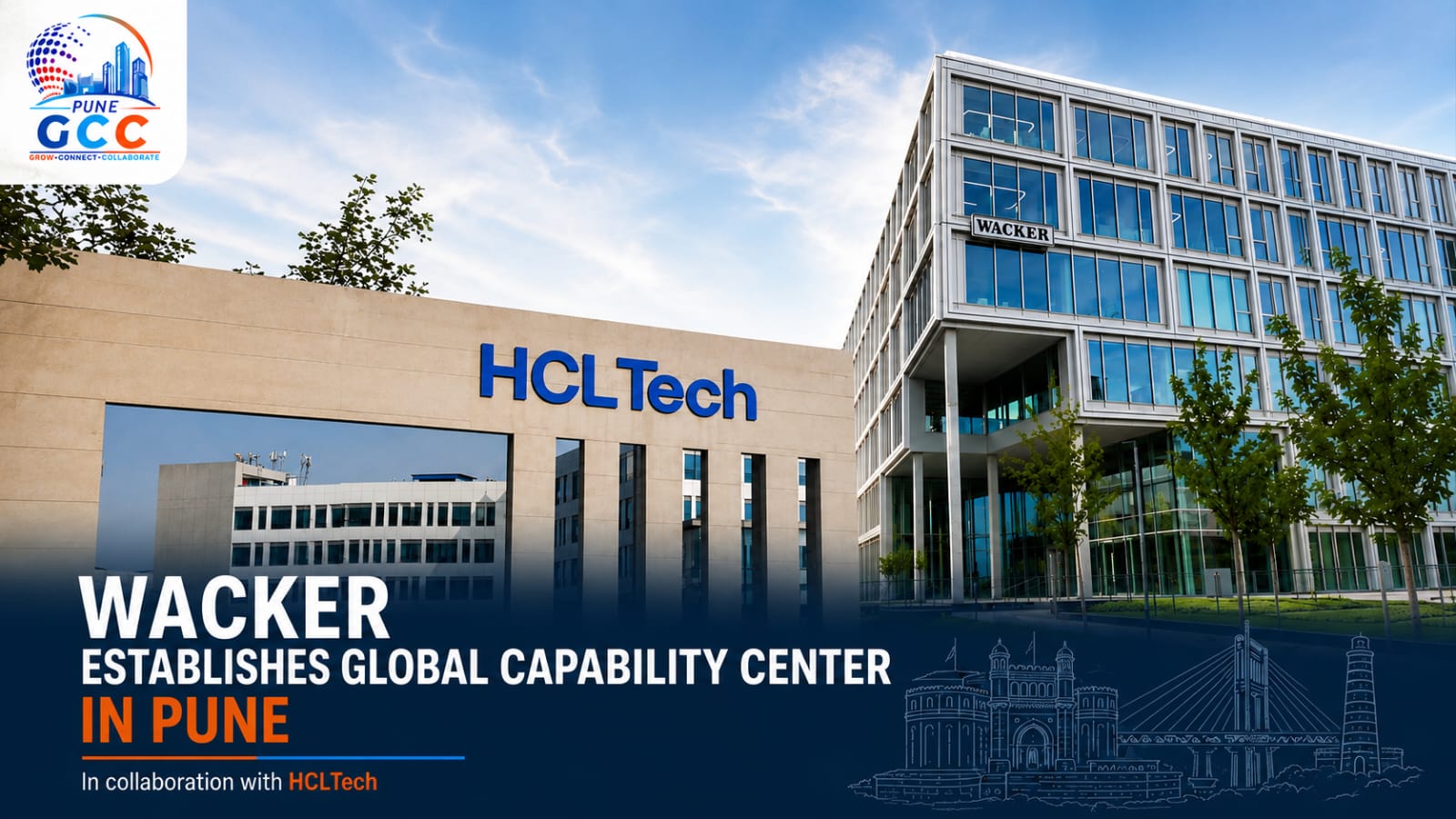
  • WACKER Establishes Global Capability Center in Pune in Collaboration with HCLTech

    WACKER Establishes Global Capability Center in Pune in Collaboration with HCLTech

    German chemicals and biotechnology major WACKER Chemie AG has established a new Global Capability Center (GCC) in Pune in collaboration with HCLTech, further strengthening Pune’s position as a major hub for global technology, engineering and digital operations.

    The new center is being established to support WACKER’s global engineering, IT and digital transformation initiatives. The Pune GCC will provide the company with a flexible and scalable delivery foundation while strengthening its ability to execute technology-led transformation programs across its global operations.

    As part of the collaboration, HCLTech will leverage its capabilities in DevSecOps, automation and digital engineering to help WACKER build a high-performing technology team and establish strong operational and governance frameworks. The partnership is expected to support greater agility, operational efficiency and faster execution of WACKER’s digital modernization initiatives.

    The establishment of the Pune center reflects WACKER’s continued focus on strengthening its global technology capabilities and creating a more resilient operating model. By combining WACKER’s industry expertise with HCLTech’s technology capabilities, the new GCC is positioned to support the company’s evolving digital requirements and long-term growth.

    Pune has emerged as one of India’s leading destinations for Global Capability Centres, supported by its strong pool of engineering and technology talent, established industrial ecosystem and growing presence of multinational companies. WACKER’s decision to establish its GCC in the city adds another prominent global organization to Pune’s expanding GCC landscape.

    The development also highlights the increasing role of Pune-based GCCs in supporting global engineering, technology, automation and digital transformation functions, moving beyond traditional IT service delivery toward strategic global capabilities.

    With WACKER’s new center, Pune continues to attract global organizations looking to build specialized technology and engineering capabilities in India, reinforcing the city’s growing importance in the country’s GCC ecosystem.