
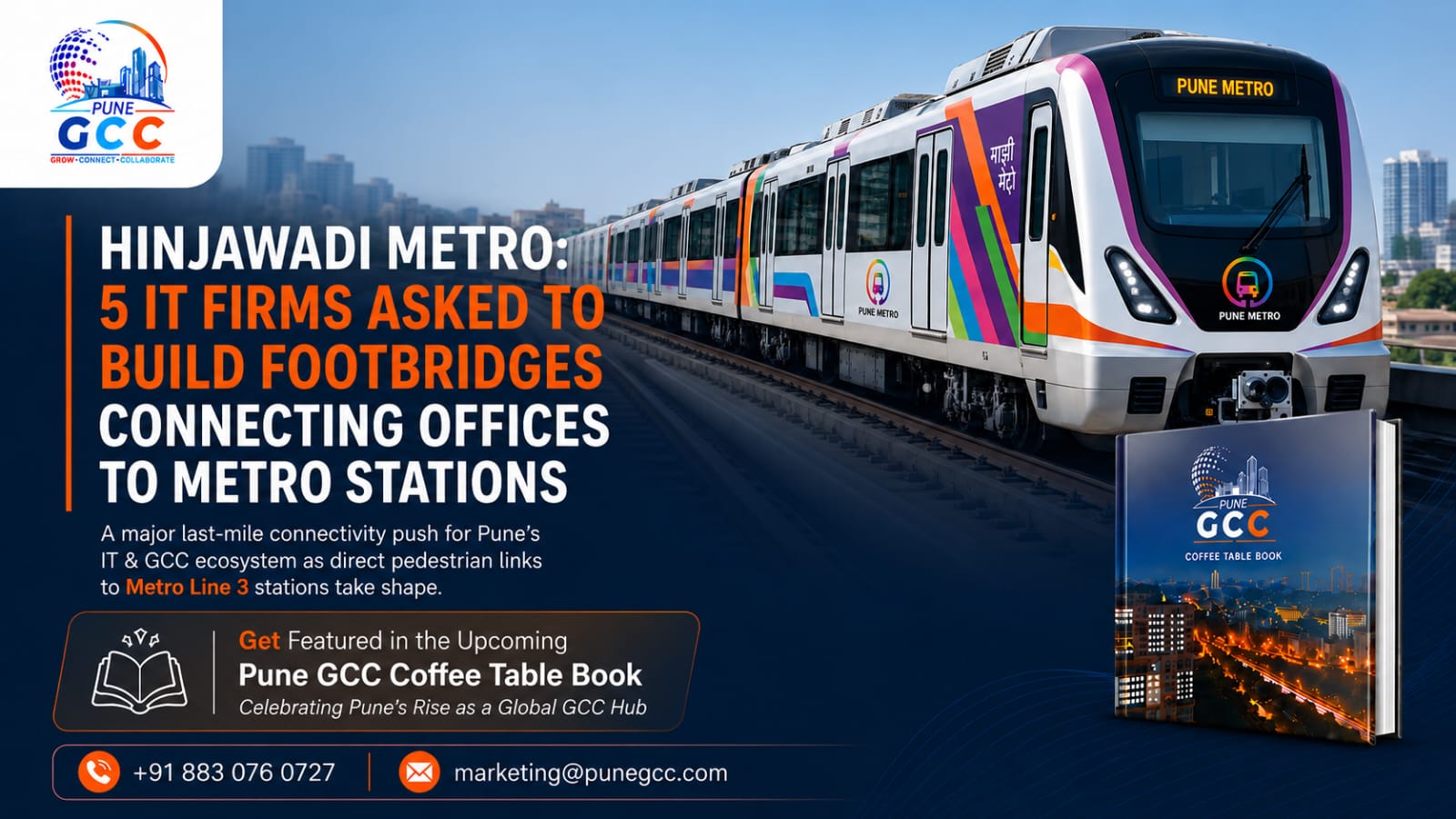
PUNE, August 29, 2026: Pune’s Hinjawadi IT and GCC ecosystem is set to receive a major last-mile connectivity boost, with the Maharashtra Industrial Development Corporation (MIDC) and Pune IT City Metro Rail Limited (PITCMRL) approaching five large IT companies to develop dedicated foot overbridges (FOBs) connecting their office campuses directly with nearby Metro stations.
The initiative comes as the Hinjawadi Metro corridor is expected to partially open next month, with authorities looking to strengthen pedestrian connectivity between major corporate campuses and the new mass-transit network. The proposed footbridges are expected to improve pedestrian safety, reduce disruption on busy roads and make daily commuting more convenient for thousands of employees working in the Hinjawadi IT hub.
Five IT Campuses Under Consideration
The five identified IT campuses collectively have a workforce of nearly 90,000 employees, underlining the potential scale of the proposed infrastructure initiative.
Under the proposed arrangement, MIDC will make available the land required for the bridge support structures, while the respective IT companies will finance and execute the construction of the foot overbridges.
According to MIDC Executive Engineer RG Totla, two companies have already expressed their willingness to undertake the projects and have received the necessary approvals.
The two proposed footbridges will provide direct pedestrian access from corporate campuses in Hinjawadi Phase 2 to the MIDC Circle, Hinjawadi Circle 1 and Hinjawadi Circle 2 Metro stations. These campuses together employ approximately 55,000 people, making the proposed connections particularly significant for daily employee movement.
Discussions Underway With Three More Companies
Authorities are also in discussions with three additional IT companies to develop similar pedestrian connections to Metro stations around Maan, Shree Shiv Chhatrapati Shivaji Maharaj Chowk, Hinjawadi and Hinjawadi Circle 1.
These establishments have an estimated combined workforce of around 32,000 employees.
MIDC officials have indicated that discussions are currently underway and expressed hope that the remaining companies will also come forward to support the proposed pedestrian infrastructure.
A Strategic Move for Pune’s GCC Ecosystem
The proposed footbridges are particularly important for Pune’s expanding Global Capability Centre (GCC) and technology ecosystem. Hinjawadi has emerged as one of the city’s most important technology and employment clusters, hosting a large concentration of multinational companies, IT services firms and global capability operations.
Direct pedestrian connections between corporate campuses and Metro stations could help address one of the key challenges associated with large employment hubs: last-mile connectivity.
For employees travelling to Hinjawadi from different parts of Pune, the Metro could provide a faster and more sustainable alternative to private vehicles. Dedicated footbridges could further improve the effectiveness of the network by allowing commuters to move directly from stations into corporate campuses without having to cross heavily trafficked roads.
Focus on Pedestrian Safety and Employee Mobility
The proposed infrastructure is also expected to address concerns over pedestrian safety and traffic movement along roads below the Metro corridor. Hinjawadi experiences significant traffic volumes during peak office hours, when thousands of employees enter and leave corporate campuses simultaneously.
By creating dedicated pedestrian links, the initiative could reduce the interaction between pedestrians and road traffic while providing a safer route for employees accessing Metro services.
The proposal has already received a positive response from commuters and local residents, particularly those concerned about pedestrian movement and traffic congestion in the Hinjawadi area.
Corporate Participation in Urban Infrastructure
The Hinjawadi footbridge initiative also represents an example of public-private collaboration in urban infrastructure. While government and Metro authorities are facilitating the required land and approvals, participating companies will take responsibility for financing and executing the pedestrian infrastructure.
Such a model could become increasingly relevant as Pune’s major employment centres expand and the city looks to integrate large corporate campuses with public transportation networks.
With thousands of employees concentrated across Hinjawadi’s IT and GCC campuses, improved integration between Metro stations, corporate offices and pedestrian infrastructure could play an important role in making the region more accessible, sustainable and employee-friendly.
As the Hinjawadi Metro corridor moves closer to partial operations, the proposed footbridges could become an important component of Pune’s broader strategy to connect its growing technology ecosystem with modern mass-transit infrastructure.