Category: News

  • thyssenkrupp Automotive Technology Opens New Engineering Centre in Pune, Targets 300+ Employees

    thyssenkrupp Automotive Technology Opens New Engineering Centre in Pune, Targets 300+ Employees

    The new facility will strengthen the company’s global R&D network, with capabilities spanning software, hardware, systems and mechanical engineering.

    Pune, India — thyssenkrupp Automotive Technology has inaugurated a new engineering centre in Pune, expanding its global research and development network and reinforcing the city’s position as a destination for advanced automotive engineering.

    The centre currently employs more than 120 engineers across software, hardware, systems and mechanical development. The company plans to expand the team to more than 300 employees over the coming years.

    Focus on Next-Generation Automotive Technologies

    The Pune engineering centre will contribute to international customer programmes and the development of next-generation steering and chassis technologies. Its areas of focus include software-defined mobility, functional safety and cybersecurity — capabilities that are becoming increasingly important as vehicles evolve towards software-driven architectures and advanced electronic systems.

    The facility will enable engineering teams in India to collaborate more closely with the company’s global development network, supporting innovation and customer requirements across international markets.

    Pune’s Growing Role in Global Engineering

    The expansion reflects the growing importance of India to thyssenkrupp Automotive Technology, extending beyond engineering into areas such as sourcing and customer development.

    Pune offers a strong automotive manufacturing ecosystem, a well-established engineering talent pool and growing expertise in software and technology development. These strengths continue to attract investments in advanced engineering and R&D capabilities from global companies.

    Strengthening Pune’s Technology Ecosystem

    The establishment of the new engineering centre adds to Pune’s expanding portfolio of global technology and engineering operations. With capabilities spanning mechanical engineering, software development, systems engineering and automotive innovation, the city continues to build its reputation as a strategic location for global companies.

    The planned expansion of the engineering team also signals opportunities for specialised talent and further development of Pune’s automotive technology ecosystem.

  • 20Cube Logistics Expands Warehousing Footprint in Pune with 1.64 Lakh Sq Ft Facility

    20Cube Logistics Expands Warehousing Footprint in Pune with 1.64 Lakh Sq Ft Facility

    Pune: 20Cube Logistics is expanding its presence in Pune with the lease of an approximately 1.64 lakh sq. ft. ready warehousing facility at Sanaswadi, strengthening its operational footprint in the region.

    The new facility will support the company’s plans to scale its logistics operations across Pune, which continues to emerge as an important industrial and logistics corridor in India.

    The expansion is expected to create new employment opportunities while enabling 20Cube Logistics to enhance its operational capabilities and serve growing business requirements in the region.

    The development also reflects the continued demand for modern warehousing and industrial infrastructure around Pune. With its strong connectivity, established industrial base and proximity to major consumption and manufacturing markets, the region remains an attractive destination for logistics and supply-chain companies.

    The expansion by 20Cube Logistics adds to Pune’s growing industrial and logistics ecosystem and further reinforces the city’s position as a strategic location for companies seeking to scale their operations in western India.

  • Innovecture and Nexio Expand Strategic Technology Partnership with Global Engineering Center in Pune

    Innovecture and Nexio Expand Strategic Technology Partnership with Global Engineering Center in Pune

    Pune, October 2026: U.S.-based technology and engineering services firm Innovecture and U.S.-based payments technology company Nexio have expanded their strategic technology partnership through a Global Engineering Center (GEC) in Pune, further strengthening the city’s position as a global engineering and technology hub.

    The relationship between the two companies began in 2024 and has since evolved into a broader engineering partnership supporting Nexio’s global technology priorities. Through the Pune GEC, Nexio is expanding its technology presence in India to access specialised engineering talent, accelerate innovation and build greater flexibility into its global technology organisation.

    The Pune-based engineering team currently supports Nexio across several technology functions, including digital transformation, artificial intelligence and data, application modernisation, quality engineering, application support and IT operations.

    The expanded GEC will operate as an extension of Nexio’s global technology team, connecting engineering teams across India and the United States around common product objectives, technology priorities and innovation initiatives.

    The center will bring together capabilities spanning software engineering, data, AI, automation, quality engineering, application modernisation and IT operations. This integrated model is expected to provide Nexio with a scalable foundation to expand its technology and engineering capabilities while increasing the adoption of AI and automation.

    The Innovecture-Nexio partnership reflects the broader evolution of India’s role in global technology operations.

    Rather than functioning solely as a traditional offshore delivery centre, the Pune GEC is being positioned as an integrated part of Nexio’s global technology organisation. The model combines Nexio’s payments and product expertise with Innovecture’s engineering talent, technology capabilities and delivery ecosystem.

    The collaboration will support areas including payments technology, software engineering, AI, data, quality engineering and platform modernisation.

    The development also comes as global companies increasingly use Pune to build specialised engineering capabilities, access technology talent and support innovation across international operations.

    The expansion of the Innovecture-Nexio partnership adds to Pune’s growing profile as a strategic destination for Global Capability Centres, engineering organisations and technology innovation.

    The Pune GEC is expected to provide a platform for deeper collaboration between teams in India and the U.S., while supporting Nexio’s long-term technology roadmap.

    With increasing activity across AI, cloud, engineering, digital transformation and advanced technology functions, Pune continues to strengthen its role in the global technology ecosystem.

  • Colliers Facilitates ~170,000 Sq. Ft. Grade A Office Transaction for Leading IT Firm in Pune

    Colliers Facilitates ~170,000 Sq. Ft. Grade A Office Transaction for Leading IT Firm in Pune

    Pune, October 2026: Pune’s commercial real estate market continues to demonstrate strong demand for quality office infrastructure, with Colliers facilitating a significant Grade A office space transaction for a leading IT firm.

    The transaction involves approximately 170,000 sq. ft. of conventional office space at GBB, Kothrud, marking a significant office real estate deal in one of Pune’s supply-constrained micro-markets.

    The transaction was supported by Colliers’ Pune office services team, with Amruta Chandratre and Sakshi Talwad playing a key role in understanding the client’s requirements and identifying a suitable workplace solution.

    Navigating limited supply while balancing the priorities of multiple stakeholders, the team successfully facilitated the transaction through a collaborative and solution-oriented approach.

    The deal reflects the continued demand from technology and corporate occupiers for large-format, Grade A office spaces in Pune. As the city strengthens its position as a major technology, innovation and Global Capability Centre (GCC) destination, demand for strategically located and high-quality workplaces is expected to remain an important component of Pune’s commercial real estate growth.

    The Kothrud transaction further highlights the evolving nature of Pune’s office market, where occupiers are increasingly seeking spaces that align with their operational requirements, employee needs and long-term growth plans.

  • Pune’s GCC Ecosystem Gains Momentum as Office Leasing Reaches Decade High in H1 2026

    Pune’s GCC Ecosystem Gains Momentum as Office Leasing Reaches Decade High in H1 2026

    Pune, October 2026: Pune’s office market recorded a strong first half of 2026, with Grade-A gross office absorption reaching 6.4 million sq. ft., marking a 56% year-on-year increase and the highest half-yearly absorption recorded in the city in the last decade, according to the Savills India Office Market Watch – H1 2026.

    The performance also highlights the growing importance of Global Capability Centres (GCCs) in Pune’s commercial office ecosystem.

    GCCs Account for 42% of Pune’s Office Absorption

    GCCs leased approximately 2.7 million sq. ft. of office space in Pune during H1 2026, accounting for nearly 42% of the city’s total gross absorption.

    Among India’s top six office markets, Pune ranked as the third-largest GCC leasing market during H1 2026. The report notes transactions involving organisations such as BP Business Solutions, Accenture Solutions, Maersk Global Service Centres, Deutsche India, Optum Health & Technology and Boston Scientific, reinforcing the city’s position as an important destination for GCC operations.

    Technology Remains a Major Demand Driver

    Pune’s office demand remained diversified during the first half of 2026.

    The IT-BPM sector accounted for 40% of gross office absorption, followed by flexible workspaces at 16% and engineering & manufacturing at 15%. Healthcare & pharma accounted for 8%, while BFSI contributed 6%.

    This mix reflects Pune’s established strengths across technology, engineering, manufacturing and other knowledge-intensive industries.

    The report also notes that Pune’s GCC profile has strengthened over the past few years, with the GCC share of office absorption increasing from 39% to 45% between H1 2022 and H1 2026. The growth has been supported by demand from technology, engineering and manufacturing occupiers.

    Large-Scale Occupiers Continue to Shape the Market

    Large office transactions remained a defining feature of Pune’s H1 2026 market. Transactions of 100,000 sq. ft. and above accounted for 56% of total leasing activity, reflecting continued expansion by global occupiers and large enterprises.

    At the city level, the SBD East micromarket accounted for 44% of total absorption, followed by PBD West at 31%, SBD West at 14% and CBD at 10%.

    What the Numbers Mean for Pune’s GCC Ecosystem

    The H1 2026 data indicates that Pune’s GCC story is increasingly connected to the city’s broader office and business ecosystem.

    The combination of a strong technology base, engineering and manufacturing capabilities, skilled talent and an established commercial real estate market is supporting continued demand from global enterprises.

    With Pune’s office absorption reaching 6.4 million sq. ft. in H1 2026, and GCCs contributing approximately 2.7 million sq. ft., the city continues to strengthen its position within India’s evolving GCC landscape.

    Pune GCC Outlook

    Savills expects Pune’s office market to record approximately 9.0 million sq. ft. of gross absorption during 2026. Technology is expected to remain the primary driver of leasing demand in H2 2026, while flexible workspaces are expected to sustain their momentum. Healthcare & pharma, real estate, and research & consulting are also expected to contribute to leasing activity.

    For Pune’s GCC ecosystem, the trajectory highlights a broader shift: GCCs are increasingly becoming an anchor of office demand, while Pune’s technology, engineering and manufacturing strengths continue to support the city’s evolution as a global business destination.

  • Hinjewadi–Shivajinagar Metro Nears Passenger Operations: A Major Connectivity Boost for Pune’s GCC Hub

    Hinjewadi–Shivajinagar Metro Nears Passenger Operations: A Major Connectivity Boost for Pune’s GCC Hub

    Pune’s Hinjewadi–Shivajinagar Metro Line 3 is moving closer to passenger operations, marking an important development for one of the city’s most significant technology and employment corridors.

    Five additional stations on the corridor have received safety clearance from the Commissioner of Metro Rail Safety (CMRS), taking the total number of stations cleared for passenger operations to 17 out of the planned 23. Officials have indicated that the remaining technical requirements are expected to be completed within the next 10–12 days.

    Why it matters for Hinjewadi

    Hinjewadi is one of Pune’s most important technology clusters and hosts a large concentration of IT companies, technology centres and Global Capability Centres (GCCs).

    The Metro Line 3 corridor has been planned specifically to improve connectivity between Hinjewadi and central Pune. According to PMRDA, the project is intended to address traffic challenges around Rajiv Gandhi IT Park, Hinjewadi and surrounding areas while supporting sustainable urban development.

    The elevated corridor stretches 23.203 km and comprises 23 stations, connecting key locations including Hinjewadi, Wakad, Balewadi, Baner and Shivajinagar.

    Connectivity and Pune’s GCC ecosystem

    For Pune’s growing GCC ecosystem, connectivity is an increasingly important part of the city’s business infrastructure.

    The Hinjewadi region serves as a major employment destination for technology and corporate professionals. Improved mass-transit connectivity can make commuting between the western technology corridor and central Pune more accessible, while strengthening connections between residential areas, commercial districts, educational institutions and employment hubs.

    The wider connectivity plan also includes a ₹426 crore last-mile connectivity project around Hinjewadi, aimed at improving access for metro passengers and nearby IT parks.

    As Pune continues to expand its presence as a GCC destination, infrastructure developments such as Metro Line 3 are becoming an important part of the city’s broader growth narrative.

    The Hinjewadi–Shivajinagar corridor is therefore not just a metro project—it is another piece of the infrastructure supporting Pune’s evolving technology and GCC ecosystem.

    Pune GCC will continue tracking the infrastructure, policy and business developments shaping Pune as a leading Global Capability Centre destination.

  • Citi Expands Pune Footprint with ~1 Million Sq. Ft. Office Space

    Citi Expands Pune Footprint with ~1 Million Sq. Ft. Office Space

    Pune’s GCC ecosystem gets another significant boost as Citi expands its presence in Kharadi.

    Pune continues to attract large-scale global operations, with Citi taking approximately 1 million sq. ft. of office space at Panchshil Business Hub in Kharadi.

    The expansion marks Citi India’s largest office space to date and is another important milestone in the company’s long-standing presence in Pune. Citi’s association with the city goes back to 2012, when it began its presence at EON Free Zone.

    A growing global operation

    Citi’s presence in India has grown considerably over the years. Its Citi Solutions Centers in India are now home to more than 35,000 colleagues, supporting businesses across more than 80 markets globally.

    Teams in India work across a wide range of functions, including technology, operations, analytics, risk, compliance and financial processes, as well as digital banking and emerging technologies.

    The latest expansion adds further scale to Citi’s operations in Pune.

    What it means for Pune

    For Pune’s GCC ecosystem, the development is another example of how global companies are continuing to expand their operations in the city.

    Kharadi has become an important location for BFSI and GCC operations, with companies increasingly using Pune to manage technology, analytics, operations and other global business functions.

    Citi’s expansion also reflects the changing scale of Pune’s GCC landscape. What was once largely associated with technology and IT services has developed into a much broader ecosystem spanning financial services, technology, analytics, risk management, operations and specialised global functions.

    As more global organizations deepen their presence in Pune, the city continues to strengthen its role as an important hub for global capability and business operations.

  • Pune Strengthens Japan Partnership, Invites Japanese Companies to Establish Global Service Centres

    Pune Strengthens Japan Partnership, Invites Japanese Companies to Establish Global Service Centres

    Pune, September 2026: Pune is looking to strengthen its economic and industrial relationship with Japan by inviting Japanese companies to invest in the city and establish regional offices and Global Service Centres.

    The development comes as Pune and Japan’s Okayama city prepare to mark 20 years of their sister-city relationship.

    During a recent courtesy visit to Japan, Pune Mayor Manjusha Deepak Nagpure met Ryuta Ibaragi, Governor of Okayama Prefecture. The discussions focused on strengthening economic, industrial, cultural and skill-development cooperation between Pune and Okayama.

    During the interaction, Pune highlighted its strengths across automotive, information technology, education, research and innovation and invited companies from Okayama to explore investment opportunities in the city.

    Japanese companies were also encouraged to consider Pune for regional offices and Global Service Centres, with the Pune Municipal Corporation indicating that it would support efforts to create a conducive environment for Japanese businesses.

    Potential areas of collaboration discussed include modern agricultural technology, healthcare, Ayurveda, yoga, research and other emerging sectors.

    A proposed joint skill-development and language centre in Pune is another key element of the discussions.

    The proposed centre could provide training in the Japanese language, Japanese work culture and technical skills, helping develop a talent pipeline for Japanese companies operating or planning to establish operations in Pune.

    Such an initiative could also strengthen employment opportunities for local professionals while helping Japanese businesses access talent familiar with their language and working environment.

    Pune and Okayama are preparing to commemorate two decades of their sister-city relationship.

    The Pune Mayor has proposed renewing the sister-city agreement to strengthen cooperation between the two cities in the coming years. An invitation has also been extended to the Governor of Okayama and a delegation of industrial and administrative representatives to visit Pune.

    The discussions are expected to provide further momentum to economic and cultural collaboration between the two cities.

    Greater engagement with Japanese businesses could open new opportunities for Pune’s growing Global Capability Centre (GCC) ecosystem.

    Japanese companies expanding their presence in Pune could potentially contribute to sectors such as:

    • Engineering and product development
    • Information technology and digital services
    • Research and development
    • Automotive and advanced manufacturing
    • Global business services
    • Technology and innovation

    Pune already has a strong combination of engineering talent, educational institutions, manufacturing capabilities and technology infrastructure, making the city relevant for global companies seeking specialised talent and international operations.

    The growing Japan–Pune relationship therefore represents another potential avenue for strengthening Pune’s position as a global hub for technology, engineering, innovation and business services.

  • Pune Growth Hub: $220 Billion Economic Vision by 2036 with 20 Lakh New Jobs

    Pune Growth Hub: $220 Billion Economic Vision by 2036 with 20 Lakh New Jobs

    Pune: The Pune Economic Region is set for an ambitious decade of economic and infrastructure expansion under a comprehensive roadmap prepared through NITI Aayog’s Growth Hub initiative.

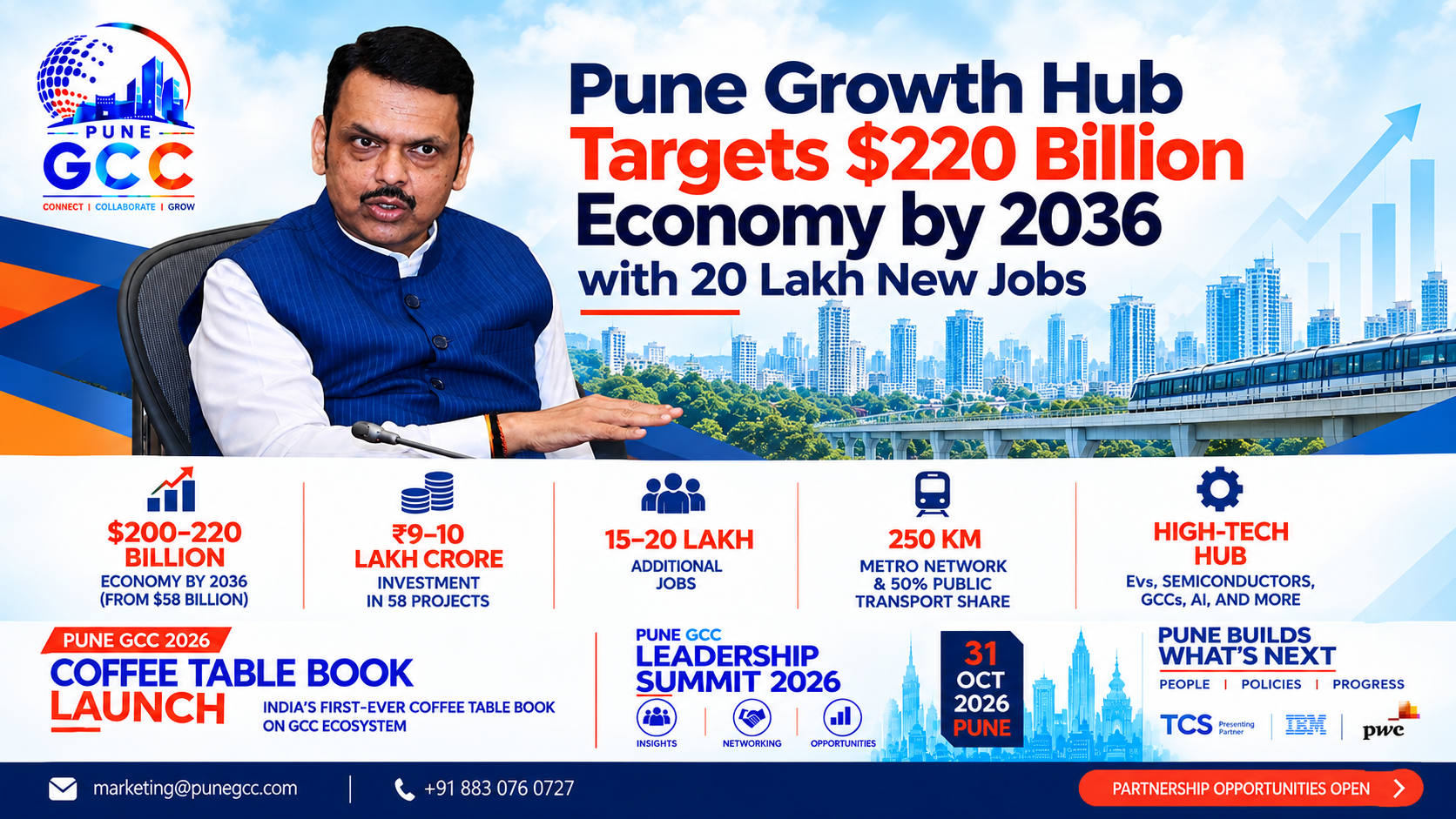
    The master plan, presented to Maharashtra Chief Minister Devendra Fadnavis at a high-level meeting at Sahyadri Guest House, proposes expanding the region’s economy from approximately $68 billion in FY 2025–26 to $200–220 billion by FY 2035–36.

    The roadmap identifies 58 priority projects, requiring an estimated ₹9–10 lakh crore in investment, with a target of creating 15–20 lakh additional jobs over the next decade.

    The plan covers the Pune Municipal Corporation (PMC), Pimpri-Chinchwad Municipal Corporation (PCMC) and Pune Metropolitan Region Development Authority (PMRDA) areas. The planning process began in August 2025 and involved NITI Aayog, the Government of Maharashtra and the Pune International Centre, with consultations involving citizens, industry and educational institutions.

    The Pune Economic Region currently contributes approximately 11–12% of Maharashtra’s overall income, while its real economic growth rate is estimated at around 6–6.5%.

    The Growth Hub roadmap proposes accelerating this rate to approximately 10% annually, supporting Maharashtra’s broader ambition of becoming a $5 trillion economy by 2047.

    With a population of around 15 million, the Pune Economic Region is being positioned for growth that combines industrial expansion, technology, infrastructure, housing, tourism and environmental sustainability.

    A major focus of the roadmap is the development of advanced manufacturing and technology-driven industries.

    The identified growth areas include:

    • Automotive and electric vehicles
    • Engineering goods and precision manufacturing
    • Defence technology
    • Robotics and drones
    • Electronics and semiconductors
    • Information technology, Global Capability Centres and artificial intelligence
    • Biotechnology and life sciences

    The roadmap proposes initiatives such as EV and future-mobility hubs, high-tech engineering parks, defence technology facilities, robotics centres, electronics and semiconductor manufacturing, IT facilities, GCCs and AI hubs.

    These high-technology sectors are expected to have the potential to generate 4–5 lakh additional jobs.

    For Pune’s growing GCC ecosystem, the emphasis on Global Capability Centres, AI, advanced engineering, electronics, semiconductors and high-tech manufacturing could create additional opportunities for global companies establishing or expanding operations in the region.

    Employment generation is one of the central objectives of the Growth Hub roadmap.

    Pune currently has approximately 56 lakh jobs, while the plan envisages total employment increasing to around 74–76 lakh over the next decade.

    The additional employment opportunities are expected to emerge across manufacturing, technology, services, healthcare, education, tourism, agriculture, food processing, logistics and related sectors.

    The roadmap also proposes expanding the startup ecosystem to more than 10,000 active ventures and reskilling 1.5–2 lakh technology professionals in areas including AI, cloud computing and cybersecurity.

    Mobility is another major pillar of the proposed transformation.

    The Growth Hub plan targets increasing the share of public transport in daily travel from approximately 13% to 50%.

    The proposed infrastructure expansion includes:

    250 km of Metro network

    12,000–14,000 city buses

    11 railway projects

    13 major road projects

    Six multimodal transport hubs

    The objective is to create a more integrated regional transport system while reducing dependence on private vehicles and improving connectivity between residential, industrial and employment centres.

    With employment and population expected to grow, housing has been identified as an important component of the roadmap.

    The plan proposes 4–5 lakh affordable homes for different income groups, workers, students and technology professionals.

    This includes approximately one lakh hostel units for industrial workers.

    The roadmap also proposes cluster-based redevelopment and aims to rehabilitate around 90% of eligible slum-dwelling families by 2036.

    Tourism is another major growth opportunity identified in the roadmap.

    The plan proposes developing multiple tourism segments, including heritage, adventure, wellness, events, wildlife and religious tourism.

    Among the proposals are a Chhatrapati Shivaji Maharaj Fort Circuit connecting Shivneri, Lohagad, Rajgad and Sinhagad; water tourism hubs around Pawna and Bhatghar; a 600-km Sahyadri trekking trail; a Junnar leopard safari; wellness and medical tourism initiatives; and event and entertainment infrastructure around the Pune International Exhibition and Convention Centre.

    The broader objective is to position the Pune Economic Region among India’s top 10 tourism destinations.

    The roadmap also looks beyond Pune’s urban economy, with agriculture and food processing identified as important drivers for the region’s rural belts.

    The plan targets increasing the combined Gross Value Added from agriculture and food processing from approximately $5 billion to $10–12 billion.

    Priority areas include horticulture, dairy, food processing, cold storage and cold-chain infrastructure, with products such as grapes, bananas, pomegranates, figs and strawberries identified as opportunities. Biofuel-related initiatives are also proposed.

    The roadmap estimates that the Pune Economic Region could require an additional 200 million litres of water per day as population and economic activity expand.

    Proposed measures include additional water allocation, supplies from the Bhama basin, wastewater reuse, improved distribution efficiency and desilting of water-storage infrastructure.

    The objective is to strengthen water security alongside long-term urban and industrial expansion.

    The proposed economic transformation is accompanied by a strong focus on skills.

    Training and reskilling initiatives are expected to focus on areas such as electric vehicles, electronics, robotics, biotechnology, artificial intelligence, cloud computing and cybersecurity.

    The roadmap also places emphasis on increasing workforce participation and creating opportunities for young people and women.

    To coordinate the implementation of the Growth Hub roadmap, a multi-level governance structure has been proposed.

    The framework includes a Governing Council chaired by the Chief Minister, a State Steering Committee headed by the Chief Secretary, a Pune Growth Hub Steering Committee, and a Project Management Unit associated with PMRDA.

    The proposed structure is intended to coordinate multiple government departments and agencies involved in infrastructure, industry, transport, housing and other development projects.

    The proposed Growth Hub strategy has particular relevance for Pune’s rapidly developing Global Capability Centre ecosystem.

    The roadmap explicitly identifies GCCs, information technology and artificial intelligence among the areas for future growth, alongside semiconductors, advanced engineering, electronics, defence technology, robotics and EVs.

    As these sectors expand, Pune’s role could increasingly connect global technology operations with advanced manufacturing, engineering, R&D and innovation capabilities.

    For the Pune GCC ecosystem, the next decade could therefore involve not only an increase in the number of centres, but also greater diversification into AI, engineering, product development, cybersecurity, semiconductor technology, advanced manufacturing and global R&D functions.

    The Pune Growth Hub roadmap presents a long-term development framework built around a combination of economic growth, technology, manufacturing, employment, mobility, housing, tourism and sustainability.

    Its headline targets — a $200–220 billion economy, ₹9–10 lakh crore of proposed investment, 15–20 lakh additional jobs and a 250-km Metro network by 2036 — underline the scale of the proposed transformation.

    The implementation of these ambitions will depend on project execution, financing, inter-agency coordination, policy decisions and timelines adopted by the government.

    For Pune, however, the roadmap provides a clear indication of the direction being proposed for the region’s next phase of growth: more technology, deeper industrial capabilities, stronger global connectivity and a larger role in Maharashtra’s economic future.

    Pune GCC will continue to track developments around the Pune Growth Hub, GCC expansion, technology investments and the evolving business ecosystem across the Pune Economic Region.

  • Beck & Pollitzer India Inaugurates New Office in Pune

    Beck & Pollitzer India Inaugurates New Office in Pune

    Pune, Maharashtra: Beck & Pollitzer India has inaugurated its new office in Pune, marking a new chapter for the company’s growing team and presence in the city.

    The inauguration was attended by Romain Prouvost, CEO of Beck & Pollitzer, who joined Suhas Kulkarni, Managing Director of Beck & Pollitzer India, and the India team to mark the occasion.

    A New Space for a Growing Team

    The new Pune office comes as Beck & Pollitzer India continues to expand its team. The company said the new space has been established to accommodate its growing workforce and support the team’s next phase of development.

    The inauguration also reflected the company’s connection with Pune’s local culture. As part of the welcome, members of the Beck & Pollitzer India team wore the Puneri Pagadi, the traditional turban associated with the city and its cultural heritage.

    The occasion brought together the company’s leadership and Pune team to celebrate the office opening and the progress of its India operations.

    Strengthening Presence in Pune

    The new office adds to Beck & Pollitzer’s presence in India and reflects the company’s continued development of its local team.

    With Pune emerging as an important destination for global companies establishing and expanding their operations, the opening of Beck & Pollitzer’s new office represents another addition to the city’s growing international business ecosystem.

    Beck & Pollitzer India’s new Pune office marks the beginning of its next chapter as the team continues to grow and build its presence in the city.

    Pune GCC Perspective

    The development is another example of a global company strengthening its footprint in Pune, contributing to the city’s expanding ecosystem of international businesses, leadership teams and global operations.